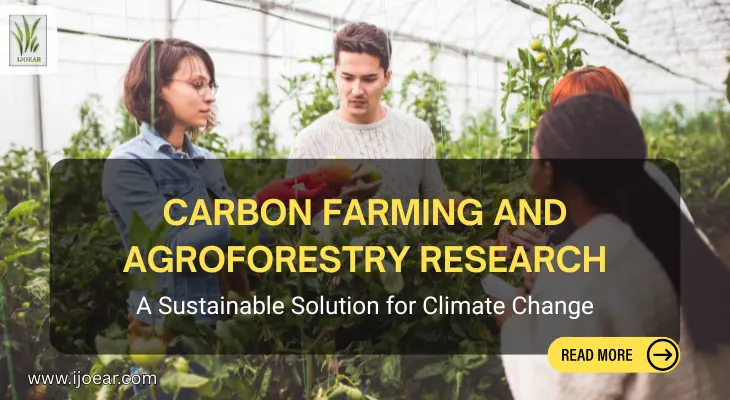
Climate change is a big challenge for farmers and the environment. Carbon farming and agroforestry are two sustainable farming methods that help reduce carbon dioxide (CO₂) in the air while improving soil health. Researchers are studying how these practices can fight climate change and support farmers.
In this blog, we will discuss:
- What is carbon farming?
- What is agroforestry?
- How do they help the environment?
- Latest research on carbon farming and agroforestry
- Benefits for farmers and the planet
What is Carbon Farming?
Carbon farming is a way of growing crops and raising animals that stores more carbon in the soil and plants. Instead of releasing CO₂ into the air, these practices keep carbon underground, which helps fight global warming.
Common Carbon Farming Techniques:
- Cover Cropping - Growing plants like clover or grasses between main crops to keep soil healthy.
- No-Till Farming - Avoiding plowing to prevent carbon loss from the soil.
- Rotational Grazing - Moving livestock to different fields to improve grass growth and soil carbon.
- Composting - Adding organic waste to soil to increase carbon storage.
What is Agroforestry?
Agroforestry is a farming method where trees and crops (or animals) are grown together. This system has many benefits, such as:
- Storing carbon in trees and soil
- Preventing soil erosion
- Providing shade and shelter for crops and animals
- Increasing biodiversity (more plants and animals)
Types of Agroforestry Systems:
- Alley Cropping - Growing crops between rows of trees.
- Silvopasture - Combining trees, grass, and livestock grazing.
- Windbreaks - Planting trees to protect crops from wind damage.
- Forest Farming - Growing crops under the shade of a forest.
How Do Carbon Farming and Agroforestry Help the Environment?
- Reduce CO₂ in the Air - Plants and trees absorb CO₂ and store it in soil and biomass.
- Improve Soil Health - Healthy soil holds more water and nutrients, helping crops grow better.
- Prevent Land Degradation - Trees and cover crops stop soil from washing away.
- Support Wildlife - More trees and plants create habitats for birds, insects, and animals.
Latest Research on Carbon Farming and Agroforestry
Scientists are studying how these farming methods can fight climate change while improving food production. Some key findings include:
- Carbon Storage Potential - A study found that agroforestry can store 5-10 times more carbon than regular farming.
- Economic Benefits - Farmers using carbon farming techniques often spend less on fertilizers and get higher yields.
- Climate Resilience - Agroforestry helps farms survive droughts and floods by improving soil and water retention.
- Government Support - Many countries now offer carbon credits to farmers who use these eco-friendly methods.

Benefits for Farmers and the Planet
For Farmers:
- Lower costs (less need for chemical fertilizers)
- Better crop yields over time
- Extra income from carbon credit programs
For the Planet:
- Less CO₂ in the atmosphere
- More forests and wildlife
- Healthier soil and water systems
Top Universities for Carbon Farming & Agroforestry Research
- Wageningen University & Research (Netherlands)
- Focus: Sustainable agriculture, soil carbon sequestration, agroforestry systems.
- Key Research: Climate-smart farming, carbon credit models for farmers.
- University of California, Davis (USA)
- Focus: Carbon farming practices, soil health, and agroecology.
- Key Research: Carbon sequestration in vineyards, rangeland management.
- ETH Zurich (Switzerland)
- Focus: Climate change mitigation, agroforestry, and carbon storage.
- Key Research: Global carbon farming potential, policy impacts.
- Swedish University of Agricultural Sciences (SLU)
- Focus: Agroforestry, regenerative agriculture, and carbon-neutral farming.
- Key Research: Boreal agroforestry systems, carbon balance in soils.
- University of Queensland (Australia)
- Focus: Carbon farming in tropical regions, soil carbon projects.
- Key Research: Grazing land management, biochar for carbon storage.
- World Agroforestry Centre (ICRAF) - Kenya
- Focus: Global agroforestry solutions, smallholder farming.
- Key Research: Carbon credit systems, tree-crop interactions.
- Cornell University (USA)
- Focus: Sustainable agriculture, carbon sequestration in soils.
- Key Research: No-till farming, agroforestry for climate resilience.
- University of Edinburgh (UK)
- Focus: Carbon capture in agriculture, agroforestry economics.
- Key Research: Peatland restoration, policy frameworks.
- University of São Paulo (Brazil)
- Focus: Amazon agroforestry, carbon farming in tropical climates.
- Key Research: Silvopasture, reforestation with crops.
- University of Nairobi (Kenya)
- Focus: Dryland agroforestry, carbon projects in Africa.
- Key Research: Farmer-led carbon sequestration methods.
Why These Universities?
These institutions are leaders because they:
- Conduct field-based research with real-world applications.
- Work with farmers, governments, and NGOs to implement solutions.
- Publish high-impact studies on carbon farming and agroforestry.
How to Get Involved?
- Students: Look for agriculture, forestry, or environmental science programs.
- Researchers: Check funding opportunities in carbon farming projects.
- Farmers: Some universities offer training programs on carbon-smart techniques.
Carbon farming and agroforestry are powerful tools to fight climate change while helping farmers. Research shows that these methods can store carbon, improve soil, and increase farm profits. Governments and farmers must work together to adopt these sustainable practices for a greener future.