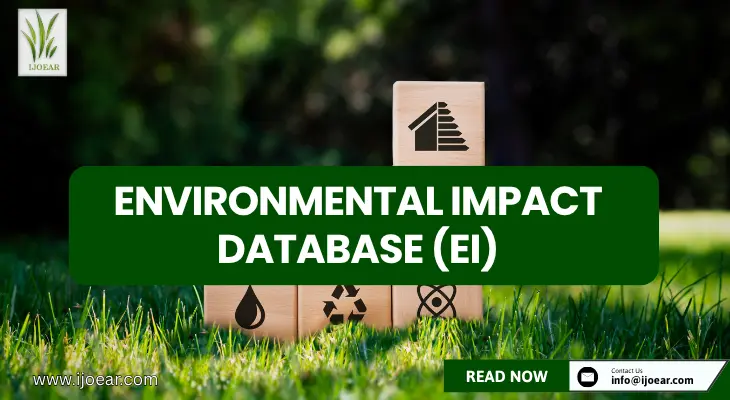
The environmental challenges we face today demand informed decisions grounded in credible research. Databases like the Environmental Impact Database (EI) serve as essential resources for scientists, policymakers, and educators working toward sustainable solutions.
What is the Environmental Impact Database (EI)?
The Environmental Impact Database (EI) is a comprehensive platform dedicated to cataloging information about:
- Environmental Hazards: From climate change to pollution and biodiversity loss.
- Sustainability Initiatives: Documenting case studies, research papers, and reports on sustainable practices.
- Policy Implications: Supporting policymakers with evidence-based insights for environmental legislation and planning.
Why Researchers Rely on the EI Database
The EI Database is invaluable for those exploring the complexities of environmental science because it provides:
- Holistic Coverage: Encompassing diverse fields such as ecology, environmental engineering, and renewable energy.
- Credible Sources: Compiling peer-reviewed research, technical reports, and government publications.
- Strategic Insights: Enabling researchers to assess the broader implications of their studies on the environment.
Limitations of the EI Database
Despite its extensive utility, the EI Database has its constraints:
- Access Restrictions: Many resources in the database may require subscriptions or institutional access.
- Static Content: The database lacks interactive features like forums or collaboration tools for researchers.
- No Publication Platform: It catalogs existing work but does not facilitate new research dissemination.
IJOEAR: A Complementary Platform for Environmental Researchers
For researchers aiming to publish and amplify their findings in environmental science, IJOEAR (International Journal of Environmental and Agriculture Research) offers a robust solution.

How IJOEAR Supports Environmental Research
- High Standards of Credibility: With a NAAS Rating of 4.23, IJOEAR is recognized for its impactful contributions to environmental and agricultural research.
- Open Access Advantage: Unlike EI, IJOEAR ensures your full-text articles are freely accessible to a global audience.
- Collaborative Publication Process: Our peer-reviewed platform enhances research quality through constructive feedback.
- Global Visibility: Published articles are indexed and promoted, increasing their impact.
Why Publish with IJOEAR?
| Feature | EI Database | Agriculture Journal IJOEAR |
|---|---|---|
| Purpose | Cataloging existing research | Publishing original research |
| Access | Often subscription-based | Fully open access |
| Interactivity | Static resource | Engaged peer-review and author support |
| Research Dissemination | Not applicable | Global distribution of articles |
Benefits of Publishing in IJOEAR:
- Enhance Credibility: A NAAS-accredited journal ensures your work is held to high standards.
- Reach Diverse Audiences: From researchers to policymakers, your work will make a tangible impact.
- Save Time: Our streamlined review and publication process ensures your research reaches readers swiftly.
- Promote Your Work: We offer tailored tools like shareable infographics and research highlights for broader visibility.
Bridging EI Database and IJOEAR
While the EI Database is an excellent resource for accessing environmental literature, IJOEAR provides the platform to share and expand upon these insights. Together, they form a powerful ecosystem for advancing environmental science and promoting sustainable practices.
Join the Global Movement Toward Sustainability
If the EI Database has enriched your research, let IJOEAR be the next step in amplifying your contribution to environmental science. With our robust peer-review process, global reach, and open-access model, your research will make the impact it deserves.
Recommended Read:
- What is NAAS Rating
- NAAS Rated Journals 2025
- How NAAS score is Calculated for Journals
- Catagory wise NAAS Journals
- Top Scopus-Indexed Journals: in Agriculture, Environment, and Food Science
- Web of Science Journals- IJOEAR
- Top AGRICOLA Indexed Journals: in Agriculture, Environment, and Food Science
- Agricultural Production Systems Simulator (APSIM)- IJOEAR
- CropSyst: Crop Simulation Model
Recommended Read:
- What is NAAS Rating
- NAAS Rated Journals 2025
- How NAAS score is Calculated for Journals
- Catagory wise NAAS Journals
- Top Scopus-Indexed Journals: in Agriculture, Environment, and Food Science
- Web of Science Journals- IJOEAR
- Top AGRICOLA Indexed Journals: in Agriculture, Environment, and Food Science
- Agricultural Production Systems Simulator (APSIM)- IJOEAR
- CropSyst: Crop Simulation Model