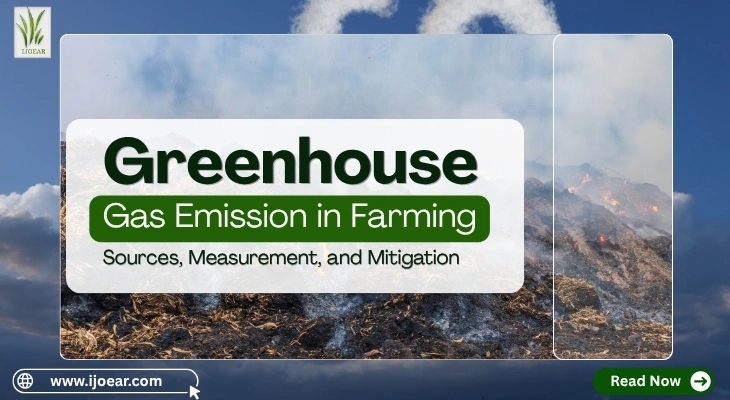
Agriculture is essential for food security, rural livelihoods and economic development—but farming also contributes significantly to climate change. Crop production, livestock, fertilizer use, rice cultivation, manure management, land-use change and on-farm energy consumption can all generate greenhouse gas (GHG) emissions.
At the same time, agriculture has an important role to play in climate solutions. Better nutrient management, improved livestock practices, efficient irrigation, alternate wetting and drying in rice, manure management, agroforestry and improved soil management can reduce emissions while supporting farm productivity.
Understanding where greenhouse gas emissions in farming come from, how they are measured and which mitigation strategies work is therefore critical for farmers, agribusinesses, policymakers and researchers.
According to the Food and Agriculture Organization (FAO), agrifood systems account for about one-third of total anthropogenic greenhouse gas emissions when emissions from farming, land-use change and pre- and post-production activities are considered. FAO's latest published dataset covers global, regional and country trends through 2023. For a broader perspective on climate change impacts, explore our guide on climate change and its impact.
What Are Greenhouse Gas Emissions in Farming?
Greenhouse gases are gases that absorb and re-emit infrared radiation, contributing to the warming of Earth's atmosphere.
The three gases most relevant to agricultural production are:
- Carbon dioxide (CO₂): Associated with fuel and electricity use, land-use change, biomass burning, liming and some soil-carbon changes.
- Methane (CH₄): Produced primarily by livestock digestion, manure management and flooded rice cultivation.
- Nitrous oxide (N₂O): Closely associated with nitrogen cycling in agricultural soils, including fertilizer and manure application.
Agriculture is particularly important because farming produces substantial amounts of methane and nitrous oxide, in addition to carbon dioxide.
For example, FAO reports that agriculture contributes around 40% of anthropogenic methane emissions, with livestock systems and rice cultivation being major agricultural sources.
Major Sources of Greenhouse Gas Emissions in Farming
1. Livestock and Enteric Fermentation
Ruminant animals such as cattle, buffalo, sheep and goats produce methane during digestion. Microorganisms in the rumen break down feed and generate methane, which is primarily released by the animal through belching.
This process is known as enteric fermentation.
Livestock can also generate methane and nitrous oxide through manure storage, treatment and application.
Potential mitigation measures include improving animal nutrition, increasing feed digestibility, improving animal health and productivity, better herd management, improving manure storage and treatment, and capturing biogas from manure where appropriate.
FAO identifies enteric fermentation and manure management as major sources of agricultural methane.
2. Synthetic Fertilizers and Nitrogen Management
Nitrogen fertilizer is essential for many high-yielding cropping systems, but inefficient nitrogen management can increase N₂O emissions.
When nitrogen is added to agricultural soils, microbial processes such as nitrification and denitrification can produce nitrous oxide.
Emissions can increase when fertilizer application exceeds crop requirements or when fertilizer is applied at an inappropriate time or under conditions that favor nitrogen losses.
Better nitrogen management focuses on applying the right nutrient, at the right rate, at the right time, in the right place.
Improving nitrogen-use efficiency can potentially reduce emissions while also lowering fertilizer costs and reducing nutrient losses.
3. Rice Cultivation
Flooded rice fields create oxygen-limited conditions in which microorganisms decompose organic material and produce methane.
This makes rice cultivation an important source of agricultural CH₄ emissions.
One widely studied mitigation practice is alternate wetting and drying (AWD), in which rice fields are periodically drained rather than continuously flooded.
Research synthesized through FAO indicates that AWD can substantially reduce methane emissions compared with continuous flooding, although results depend on soil, climate, water management and other site-specific conditions.
Importantly, mitigation strategies should consider both methane and nitrous oxide because reducing one gas can sometimes influence another.
4. Manure Management
Animal manure contains organic matter and nitrogen. The way manure is collected, stored, treated and applied to land affects GHG emissions.
Under anaerobic conditions, manure can produce methane. Nitrous oxide can also be released during manure storage and after manure is applied to agricultural soils.
Potential solutions include covered manure storage, anaerobic digestion, biogas recovery, improved composting where appropriate, better timing and placement of manure application, and matching manure nutrients with crop requirements.
FAO specifically identifies manure reuse, including organic fertilizer and biogas production, as potential mitigation measures.
5. Agricultural Machinery and Energy Use
Tractors, irrigation pumps, harvesters, dryers and other farm equipment may consume diesel, petrol or electricity.
The associated emissions depend on the energy source and efficiency of the equipment.
Farm-level mitigation can include efficient machinery, reduced unnecessary field operations, proper equipment maintenance, efficient irrigation pumps, solar or other renewable electricity where technically and economically suitable, and improved energy management.
Although energy-related CO₂ may be smaller than some biological sources in certain farming systems, it can be important when calculating a complete farm carbon footprint.
6. Crop Residue Burning
Burning crop residues releases greenhouse gases and other air pollutants.
Where agronomically appropriate, alternatives can include residue incorporation, composting, mulching, livestock feed use, bioenergy applications, and other forms of biomass utilization.
The best option depends on soil conditions, disease risks, nutrient requirements, machinery availability and local economics.
7. Land-Use Change and Soil Carbon Loss
Agriculture can contribute to emissions when forests, grasslands, wetlands or other carbon-rich ecosystems are converted to agricultural land.
Land-use change can release carbon stored in vegetation and soils.
Conversely, well-managed agricultural soils, trees and agroforestry systems can store carbon. However, soil-carbon sequestration has limits and varies according to climate, soil type, management, land history and other factors.
FAO's accounting framework distinguishes emissions occurring at the farm gate from land-use change and from emissions occurring before and after farm production. For more on carbon sequestration, read carbon sequestration in soils: scope in Ph.D. research.

How Are Greenhouse Gas Emissions in Farming Measured?
Measuring agricultural GHG emissions is more complicated than simply counting fuel consumption.
Agricultural emissions can originate from biological processes that vary with soil type, weather, crop type, livestock species, feed, fertilizer application, irrigation, manure management, land management, farm size and production system.
Measurement approaches generally fall into three broad categories: activity data and emission factors, direct field measurement, and modeling or remote-sensing approaches.
1. Activity Data × Emission Factors
A common approach is to estimate emissions using activity data multiplied by an appropriate emission factor.
For example: Estimated emissions = Activity data × Emission factor
Activity data could include the amount of nitrogen fertilizer applied, number and type of livestock, quantity of fuel consumed, area under rice cultivation, or quantity of manure managed.
An emission factor estimates the amount of GHG released per unit of activity.
This approach is widely used in national and sectoral inventories because it can be applied consistently across large areas.
The IPCC's AFOLU guidelines provide methodologies for estimating emissions from cropland, livestock, manure management, managed soils and related activities.
IPCC Tier 1, Tier 2 and Tier 3 Measurement Approaches
The IPCC framework uses a tiered approach.
Tier 1: Default Factors
Tier 1 uses internationally developed default emission factors and relatively basic activity data.
Advantages: Simple, relatively inexpensive, suitable where detailed local data are unavailable.
Limitation: It may not capture important differences between farms, climates, soils or management systems.
Tier 2: Country- or Region-Specific Factors
Tier 2 uses more detailed local data and country- or region-specific emission factors.
This can improve accuracy when national conditions differ significantly from the assumptions behind default factors.
Tier 3: Advanced Measurement and Modeling
Tier 3 approaches use detailed measurements, process-based models, high-resolution data or sophisticated inventory systems.
They can provide more accurate estimates but generally require more data, technical expertise, monitoring infrastructure, and greater financial resources.
The IPCC notes that moving toward higher tiers generally improves accuracy and reduces uncertainty, but also increases complexity and resource requirements.
Direct Measurement of Farm GHG Emissions
For research and field-level studies, GHGs can also be measured directly.
Closed-Chamber Method
A chamber is placed over a defined area of soil or crop. Gas samples are collected at intervals, and changes in gas concentration are analyzed to estimate the emission flux.
This method is widely used for measuring CH₄ and N₂O emissions from agricultural soils and rice fields.
Gas Chromatography
Gas chromatography can be used to determine concentrations of gases such as CH₄, N₂O, and CO₂. The concentration data can then be combined with sampling area, time and other parameters to estimate emission rates.
Micrometeorological and Advanced Techniques
Larger-scale measurements can use approaches such as eddy covariance, automated chambers, remote sensing, atmospheric measurements, drone-based monitoring, and satellite observations.
These approaches can complement traditional farm measurements and help scale observations from individual fields to larger landscapes.
Measuring a Farm's Carbon Footprint
A farm carbon footprint typically estimates the total GHG emissions associated with a defined production system and reporting period.
A simplified farm-level assessment might include:
Crop production: Fertilizer, irrigation, fuel, crop residues, soil N₂O, land-use change.
Livestock: Enteric fermentation, manure management, feed production, energy use.
Infrastructure and energy: Electricity, diesel, refrigeration, heating and drying.
The results are commonly expressed as carbon dioxide equivalents (CO₂e).
However, carbon-footprint calculations should clearly define their system boundary. A farm-gate assessment is not the same as a full life-cycle assessment of a food product.
Key Mitigation Strategies for Reducing Farming Emissions
1. Improve Nitrogen-Use Efficiency
One of the most important opportunities in crop production is improving nitrogen management.
Farmers can consider soil testing, precision fertilizer application, split applications, improved timing, better fertilizer placement, enhanced-efficiency fertilizers where appropriate, and matching fertilizer rates to crop demand.
The objective is not simply to use less fertilizer—it is to produce more efficiently with the nitrogen that is applied.
2. Adopt Improved Rice Water Management
For suitable rice-growing systems, alternate wetting and drying can reduce methane emissions and water use compared with continuous flooding.
However, implementation should be adapted to local soil, irrigation infrastructure, crop variety and water availability.
Evidence from field studies shows that the magnitude of methane reduction varies between locations, emphasizing the importance of site-specific management.
3. Improve Livestock Productivity
Increasing productivity per animal can reduce emissions intensity when the same or greater amount of food is produced with fewer resources.
Potential interventions include better feed quality, improved animal health, genetic improvement, better reproductive management, reduced mortality, and improved herd management.
The goal should be to combine emission reductions with animal welfare, farmer profitability and food-security objectives.
4. Improve Manure Management
Manure management can address both methane and nutrient losses.
Possible strategies include anaerobic digestion, covered storage, improved composting, nutrient recovery, better application timing, and biogas utilization.
Where anaerobic digestion is economically and technically feasible, captured biogas can also provide an energy source.
5. Increase Soil Carbon Where Appropriate
Practices such as cover cropping, reduced or conservation tillage, crop diversification, residue management, agroforestry, and improved grazing management can contribute to improved soil health and, in suitable circumstances, increased soil carbon stocks.
However, carbon sequestration should be measured rather than assumed, because results vary substantially by location and management system.
6. Reduce Fossil-Fuel Dependence
Farm energy efficiency can be improved through efficient irrigation, fuel-efficient machinery, solar-powered systems where appropriate, renewable electricity, improved farm logistics, and reduced unnecessary tillage and field passes.
Energy audits can help identify the activities with the greatest potential for savings.
7. Avoid Deforestation and Protect High-Carbon Ecosystems
Preventing conversion of forests, wetlands and other carbon-rich ecosystems can avoid substantial emissions.
From a climate perspective, avoiding carbon loss can be as important as trying to remove additional carbon later.
A Practical Framework for Farm GHG Management
Farmers and agricultural organizations can use a five-step approach:
Step 1: Define the Boundary — Decide whether the assessment covers individual fields, the entire farm, a livestock enterprise, farm-gate emissions, or the entire supply chain.
Step 2: Identify Major Emission Sources — Create an inventory covering CH₄, N₂O, CO₂, energy use, fertilizer, livestock, manure, rice cultivation, and land-use change.
Step 3: Measure or Estimate Emissions — Use appropriate activity data, emission factors, field measurements or models. For national inventories, the IPCC AFOLU methodology provides a standardized framework for categories including cropland, livestock, manure and managed soils.
Step 4: Prioritize Mitigation — Focus first on the sources that contribute most to the farm's footprint and where practical interventions can deliver measurable benefits.
Step 5: Monitor Results — Track indicators such as kg CO₂e per hectare, kg CO₂e per tonne of crop, kg CO₂e per kg of milk or meat, nitrogen-use efficiency, fuel use per hectare, methane emissions per animal, and soil-carbon stocks. This helps determine whether mitigation is actually delivering results.
Why Emission Intensity Matters
Total emissions are important, but emission intensity provides another useful perspective.
For example: Emission intensity = Total GHG emissions ÷ quantity of agricultural product.
A farm producing 10 tonnes of grain with 10 tonnes CO₂e has a different emission intensity from a farm producing 20 tonnes with 12 tonnes CO₂e. The second farm has higher total emissions but lower emissions per tonne of product.
This distinction is particularly important when evaluating mitigation strategies because agriculture must reduce environmental impacts while continuing to provide sufficient food.
Challenges in Measuring Agricultural GHG Emissions
Agricultural GHG accounting has several challenges.
Spatial Variability: Two fields with the same fertilizer application can produce different N₂O emissions because of differences in soil, temperature, moisture and management.
Seasonal Variability: GHG emissions can change considerably during rainfall events, irrigation, fertilizer application and periods of high biological activity.
Data Availability: Smallholder farms may not have detailed records of fertilizer use, fuel consumption, livestock feed, manure management, irrigation, or crop residues.
Measurement Costs: Direct measurement can require specialized equipment, trained personnel and repeated sampling.
Uncertainty: Emission estimates should ideally report uncertainty rather than present a single number as if it were perfectly precise.
These challenges are why agricultural GHG accounting increasingly combines field measurements, models, activity data and emerging digital technologies.
The Future of GHG Measurement in Farming
Technology is making agricultural emissions monitoring increasingly data-driven.
Future and emerging approaches include IoT sensors, automated GHG chambers, satellite imagery, drone monitoring, artificial intelligence, digital farm records, precision agriculture platforms, remote sensing, and process-based crop and livestock models.
FAO's methane work also emphasizes improving emission factors, estimation methods and monitoring, reporting and verification (MRV) systems for agricultural methane.
The long-term opportunity is to move from broad estimates toward more location-specific, affordable and actionable farm-level emissions data.
Greenhouse Gas Mitigation in Farming: The Bigger Picture
Reducing agricultural GHG emissions is not simply about adopting one technology.
Successful mitigation requires an integrated approach that considers climate + productivity + profitability + soil health + water + biodiversity + farmer livelihoods.
For example, reducing fertilizer application may lower N₂O emissions, but applying too little nitrogen could reduce yields. Similarly, changing rice irrigation practices may reduce methane but requires appropriate water control and careful management of other gases.
The best mitigation strategies are therefore those that are measurable, economically viable, locally appropriate and compatible with food production.
Greenhouse gas emissions in farming come from multiple sources, including livestock digestion, manure, nitrogen fertilizer, flooded rice fields, fossil-fuel use, crop residue burning and land-use change.
The three major agricultural greenhouse gases—CO₂, CH₄ and N₂O—behave differently and require different mitigation approaches.
Accurate measurement is the foundation for effective action. Depending on the purpose and available resources, emissions can be estimated using activity data and emission factors, IPCC tiered inventory methods, direct field measurements, models and increasingly advanced digital monitoring technologies.
Mitigation can then focus on improving nitrogen-use efficiency, managing livestock and manure, reducing methane from rice, improving soil management, increasing energy efficiency and protecting carbon-rich ecosystems.
Ultimately, the objective is not simply lower emissions, but a more productive, resilient and resource-efficient agricultural system that can feed a growing population while contributing to climate goals. For guidance on publishing research in this field, refer to how to publish agriculture research quickly and efficiently.
Continue Exploring: Recommended Reads from IJOEAR and AD Publications Blog
📚 You may also find these articles valuable for your research and academic writing journey:
- Climate Change and Its Impact — Understand climate variability effects on agriculture and food systems.
- Carbon Sequestration in Soils: Scope in Ph.D. Research — Understand soil carbon dynamics and climate mitigation potential.
- Regenerative Agriculture: Mechanisms in Carbon Sequestration and Soil Health — Discover soil health restoration practices for sustainable farming.
- What is Climate-Smart Agriculture? How it Addresses Climate Change — Explore climate-smart farming practices for mitigation and adaptation.
- How to Use Zotero for Citation — Learn to manage references and citations efficiently for your research papers.
- How to Choose the Right Citation Style: APA vs MLA vs Chicago Guide — Understand which citation style fits your academic discipline.