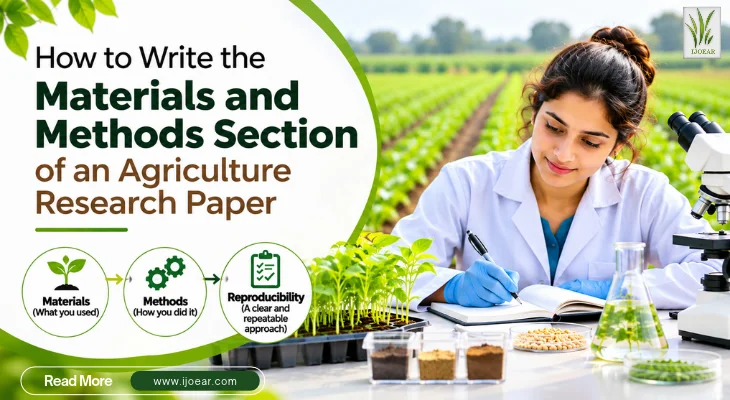
The Materials and Methods section is one of the most important components of an agriculture research paper. It explains how the research was conducted, which materials and resources were used, how data were collected, and which statistical techniques were applied to analyze the results. A well-written section allows other researchers to understand the experimental procedure, assess the reliability of the findings, and reproduce the study under comparable conditions.
Agricultural research often involves field experiments, laboratory investigations, greenhouse trials, soil analysis, crop evaluation, livestock studies, remote sensing, and statistical modelling. Each research approach requires a clear description of the methods used to obtain reliable and scientifically valid results.
Whether a study investigates crop productivity, soil fertility, irrigation management, pest control, plant breeding, or sustainable farming practices, the Materials and Methods section should provide sufficient detail without including unnecessary information. Researchers preparing a manuscript can also benefit from our guide on how to publish an agriculture research paper in an international journal.
What Is the Materials and Methods Section in Agricultural Research?
The Materials and Methods section describes the resources, experimental design, procedures, instruments, sampling techniques, and analytical methods used to conduct a study.
It answers several fundamental questions:
- Where was the research conducted?
- What materials, organisms, equipment, or datasets were used?
- How was the experiment designed?
- How were treatments assigned and applied?
- How were observations and measurements collected?
- Which statistical or computational methods were used?
- How can another researcher reproduce the study?
For example, a paper examining the effect of organic fertilizers on wheat yield should explain the experimental location, soil characteristics, wheat variety, fertilizer treatments, experimental layout, irrigation practices, data collection procedures, and statistical analysis.
The objective is not simply to list laboratory equipment or describe field activities. Instead, this section should present a logical and sufficiently detailed account of the research process.
Why Is This Section Important in Agriculture Research Papers?
Agricultural research is strongly influenced by environmental conditions, management practices, biological variability, and experimental design. Incomplete methodological descriptions can make it difficult to determine whether the findings are reliable or applicable to other farming conditions.
1. Ensures Reproducibility
Reproducibility enables other researchers to repeat a study using the described procedures and assess whether similar findings can be obtained.
For instance, a study on rice productivity should specify the variety, sowing method, fertilizer application rates, irrigation schedule, and experimental design. Merely stating that standard agricultural practices were followed does not provide enough information for meaningful replication.
2. Establishes Scientific Credibility
A transparent methodology allows reviewers to evaluate whether the research question was investigated using appropriate techniques. Clearly defined treatments, sampling procedures, measurements, and statistical analyses strengthen confidence in the research.
3. Supports Valid Statistical Interpretation
The experimental design determines how observations should be analyzed. Information about replication, randomization, experimental units, and blocking helps readers assess whether the statistical methods were appropriate.
4. Improves Research Comparability
Agricultural studies are often compared across different locations, seasons, soil types, and climatic conditions. Detailed methods help researchers identify similarities and differences between experiments and evaluate whether results can be compared meaningfully.
5. Facilitates Peer Review and Publication
Journal reviewers examine the Materials and Methods section to determine whether the study is sufficiently rigorous, ethical, transparent, and relevant to its stated objectives. A clear methodology reduces ambiguity and makes the paper easier to evaluate. For a broader view of the evaluation process, see our guide to peer review and everything you need to know.
Essential Components of the Materials and Methods Section
The exact structure depends on the research topic and the journal's author guidelines. However, most agricultural research papers include several common components.
1. Study Area and Experimental Location
Begin by identifying where the study was conducted. Field-based agricultural research should provide enough geographical and environmental information to contextualize the findings.
Relevant details may include:
- Name and geographical location of the research station, farm, laboratory, or experimental site.
- Latitude, longitude, and altitude when relevant.
- Climate classification and seasonal conditions.
- Soil type, texture, pH, organic carbon, and other relevant characteristics.
- Rainfall, temperature, humidity, and irrigation conditions during the study.
- Duration of the experiment and the agricultural seasons covered.
Not every study requires every variable. Include the environmental characteristics that could influence the research outcomes.
Example:
"The field experiment was conducted during the winter cropping season at an agricultural research farm in northern India. Before treatment application, composite soil samples were collected from the experimental field to determine soil pH, electrical conductivity, organic carbon, and available nitrogen, phosphorus, and potassium."
This is an illustrative description. A manuscript should replace general wording with the actual location, dates, measurements, and analytical details.
2. Materials, Plant Materials, and Equipment
Describe the biological materials, chemicals, instruments, software, and other resources used in the investigation.
Depending on the study, these may include:
- Crop species, cultivars, hybrids, or seed varieties.
- Fertilizers, pesticides, biofertilizers, and soil amendments.
- Soil, water, plant tissue, or microbial samples.
- Laboratory chemicals and reagents.
- Agricultural machinery and irrigation equipment.
- Sensors, drones, GPS devices, and weather stations.
- Analytical instruments and statistical software.
Where appropriate, specify the manufacturer, model, grade, concentration, source, or identification number. Include these details when they affect reproducibility or interpretation.
For plant studies, report the scientific name and relevant cultivar or accession information. For soil amendments and chemical treatments, state their composition and application rates.
Avoid lengthy inventories of routine equipment that have no bearing on the methods or results.
3. Experimental Design and Treatment Structure
The experimental design is central to agricultural research because crop performance can vary due to soil heterogeneity, weather, pest pressure, and management practices.
Explain how the experiment was organized and how treatments were assigned.
Common experimental designs include:
- Completely Randomized Design (CRD): Often used when experimental units are relatively homogeneous, including some laboratory and controlled-environment experiments.
- Randomized Complete Block Design (RCBD): Frequently used in field experiments where blocking helps account for spatial variability.
- Factorial Design: Used to investigate two or more factors and their interactions.
- Split-Plot Design: Useful when one factor is difficult to apply to small experimental units.
- Augmented Design: May be used in plant breeding when numerous test entries are evaluated alongside replicated checks.
Specify the number of treatments, replications, blocks, experimental units, and plot dimensions. Explain the factors and treatment levels and describe the randomization procedure.
For example, a fertilizer experiment might compare four nutrient-management treatments across three blocks. The paper should identify the treatments, explain how plots were allocated, and state the actual number of experimental units.
Do not treat repeated measurements from the same plot as independent experimental replications. The experimental unit must be defined correctly to avoid pseudoreplication.
4. Field Preparation and Experimental Procedures
Describe the sequence of activities used to establish and manage the experiment.
Depending on the study, relevant procedures may include:
- Land preparation and plot layout.
- Seed treatment and sowing methods.
- Plant spacing and sowing depth.
- Fertilizer type, dose, timing, and application method.
- Irrigation scheduling and water application.
- Weed, pest, and disease management.
- Transplanting, pruning, harvesting, or other crop-management operations.
- Greenhouse temperature, humidity, lighting, and nutrient conditions.
The description should be detailed enough for another researcher to understand the procedures and identify the factors that might influence the results.
Illustrative example:
"Seeds were sown at the specified row and plant spacing in each experimental plot. Fertilizer treatments were applied according to the experimental protocol, and irrigation and weed management were maintained consistently across treatments unless they formed part of the experimental factors."
In a real paper, replace general statements with actual spacing, fertilizer rates, dates, irrigation quantities, and management procedures.

5. Sampling Methods and Data Collection
Explain how observations and samples were collected. This is particularly important because inconsistent sampling can introduce bias and reduce the reliability of agricultural measurements.
For each major variable, describe:
- The sampling unit and sampling location.
- The number of samples or plants collected.
- The growth stage or sampling date.
- The sampling depth, where relevant.
- The equipment and measurement procedure.
- Sample preparation, storage, and transportation.
- Units of measurement and quality-control procedures.
For example, a soil fertility study should specify sampling depth, sampling pattern, number of subsamples, preparation procedures, and the analytical methods used to determine soil properties.
A crop-yield study should explain whether yield was measured from the entire plot or a defined harvest area, how border rows were handled, and whether grain moisture was standardized before calculating yield.
Clearly distinguish between biological replicates, technical replicates, subsamples, and repeated observations. These terms represent different sources of information and should not be used interchangeably.
6. Laboratory and Analytical Methods
Many agricultural studies involve laboratory measurements of soil, plants, water, seeds, microorganisms, or agricultural products.
Describe the analytical methods used to generate the reported measurements.
Examples include:
- Soil pH and electrical conductivity measurement.
- Soil organic carbon estimation.
- Available nitrogen, phosphorus, and potassium analysis.
- Chlorophyll and photosynthetic pigment estimation.
- Seed germination and viability testing.
- Plant nutrient analysis.
- Microbial isolation and identification.
- Pesticide residue analysis.
- Grain quality and nutritional composition testing.
For established methods, provide the method name and a reliable citation where appropriate. If the method has been modified, describe the changes. For newly developed methods, provide sufficient procedural detail for evaluation and replication.
Include relevant information about calibration, standards, detection limits, sample preparation, quality controls, and analytical conditions when these influence data quality.
Avoid citing a method without explaining how it was applied to the current study.
7. Measurement of Growth, Yield, and Other Variables
Define the main response variables and explain how they were measured or calculated.
Depending on the research objectives, measurements may include plant height, leaf area, tiller number, biomass, root length, crop growth rate, nutrient uptake, water-use efficiency, seed germination, pest incidence, or final yield.
For every major variable, identify the measurement method, timing, unit, and calculation procedure.
For example, crop yield might be expressed in kilograms per hectare or tonnes per hectare. The manuscript should explain how the harvested sample was converted to an area-based yield estimate and whether moisture correction was applied.
If derived indicators are used, provide their equations or cite an established method. Define every variable and specify its units. Ensure that the calculations are consistent with the study design and the results reported later in the paper.
8. Statistical Analysis
Statistical analysis explains how the collected data were evaluated and how differences, relationships, or treatment effects were assessed.
This subsection should identify:
- The statistical model or test used.
- The factors and interactions included in the model.
- The experimental unit and replication structure.
- The method used to check relevant model assumptions.
- The significance level or decision criterion.
- The post-hoc or multiple-comparison procedure, when applicable.
- The statistical software and version, where relevant.
- The method used to handle missing data or unusual observations, if applicable.
Agricultural studies may use analysis of variance (ANOVA), regression, correlation, mixed-effects models, generalized linear models, survival analysis, or other methods depending on the research question and data structure.
For example, a factorial field experiment may require analysis of the main effects of fertilizer and irrigation, as well as their interaction. If the experiment spans several seasons or locations, the model may need to account for season, location, blocks, or other sources of variation.
Do not select statistical tests solely because they are commonly used in agricultural papers. The analysis must match the research question, response-variable distribution, experimental design, and assumptions.
When reporting mean comparisons, specify the method used, such as Tukey's honestly significant difference test, if applicable. Avoid relying exclusively on significance labels without reporting effect sizes, variability, confidence intervals, or other useful statistical information where appropriate. For a broader discussion of method selection, see our guide to research methodology, types, importance, and examples.
How to Write the Materials and Methods Section Step by Step
A structured writing process can make this section more accurate and easier to review.
Step 1: Review the Target Journal's Author Guidelines
Before drafting, examine the journal's requirements for manuscript organization, units, statistical reporting, references, supplementary materials, and ethical declarations.
Some journals require separate subsections for experimental design, statistical analysis, or data availability. Others prefer a combined Methods section.
Following the journal's instructions reduces unnecessary restructuring during submission.
Step 2: Organize Methods Around the Research Objectives
List the objectives or hypotheses of the study and identify which methods address each one.
For example, a study examining the effects of irrigation and nitrogen management on wheat may require separate methodological descriptions for soil characterization, treatment application, crop-growth measurements, yield estimation, and statistical analysis.
This approach helps ensure that each research objective has a corresponding measurement and analysis procedure.
Step 3: Gather the Experimental Records
Use field notebooks, laboratory records, sample logs, equipment records, spreadsheets, and approved experimental protocols to verify the details.
Check dates, treatment labels, sample sizes, units, instrument settings, and calculation procedures. Accurate records are especially important when several researchers have contributed to data collection.
Never fill missing methodological details with assumptions or invented values. If a procedure cannot be verified, investigate the original records before finalizing the manuscript.
Step 4: Describe Procedures in a Logical Order
A common sequence is:
- Study location and environmental conditions.
- Materials and experimental resources.
- Experimental design and treatments.
- Crop or laboratory management procedures.
- Sampling and measurements.
- Laboratory analyses.
- Statistical analysis.
Rearrange these subsections when another sequence better reflects the actual workflow or the target journal's requirements.
Step 5: Use Precise Scientific Language
Prefer direct, factual descriptions over vague statements.
Instead of writing, "The plants were observed regularly," specify the observation schedule, growth stages, measured traits, and sampling procedure.
Instead of writing, "Soil quality was tested using standard techniques," identify the soil properties measured and the methods used to determine them.
Use consistent terminology, standardized units, and unambiguous treatment names throughout the paper.
Step 6: Include Equations Where Necessary
When reporting calculated indicators, provide the equation or cite the exact established procedure.
For example, a simple area-based yield conversion can be expressed as:
Yield (t/ha) = Harvested mass (kg) × 10 ÷ Harvested area (m²)
This conversion assumes that the harvested mass and area are measured consistently and that any necessary moisture adjustment has been completed before conversion.
Explain the variables and any correction factors used. Equations should improve transparency rather than repeat calculations that are already obvious from the text.
Step 7: Cross-Check Methods Against Results
Every major result should be traceable to a measurement or analytical procedure described in the Methods section.
If the Results section reports soil organic carbon, the Methods section should explain how it was measured. If the paper reports treatment differences in crop yield, the experimental layout and yield-measurement procedure should be clear.
Likewise, avoid describing measurements or analyses that were never performed or are not relevant to the reported study.
Example of a Materials and Methods Structure for a Field Experiment
Consider a hypothetical study evaluating different nutrient-management strategies for maize. The following outline demonstrates how the section can be organized.
Study Site
Describe the location, season, soil characteristics, climatic conditions, and relevant field history.
Experimental Design
State the design, nutrient-management treatments, number of blocks or replications, plot dimensions, and method of treatment allocation.
Crop Establishment and Management
Identify the maize variety, seed source, sowing date, spacing, fertilizer schedule, irrigation management, and other relevant crop-management practices.
Growth and Yield Measurements
Define the growth traits, sampling dates, number of plants sampled, harvesting procedure, yield calculations, and measurement units.
Soil and Plant Analysis
Describe the collection and preparation of soil or plant samples, analytical methods, equipment, and quality-control procedures.
Statistical Analysis
Specify the statistical model, experimental unit, treatment comparisons, assumptions, software, and significance criterion.
This outline is not a complete research method and should not be copied as evidence of an experiment. The actual manuscript must include the procedures, values, and analytical details documented for the real study.
Common Mistakes to Avoid
1. Providing Insufficient Experimental Detail
Descriptions such as "the experiment was conducted using standard procedures" leave important questions unanswered. Identify the relevant procedure and provide the details needed to understand and reproduce it.
2. Omitting Replication and Randomization
Failing to report the number of replications, plot allocation, or randomization method makes it difficult to assess experimental reliability.
3. Confusing Samples With Replicates
Multiple plants or soil subsamples collected from a single experimental plot do not automatically represent independent experimental units. Explain the sampling hierarchy and use an appropriate statistical model.
4. Reporting Equipment Without the Procedure
Naming a soil analyzer or sensor is not enough. Explain the relevant operating conditions, calibration, sample preparation, and measurement process.
5. Using Vague Statistical Descriptions
Statements such as "data were analyzed statistically" do not allow readers to evaluate the analysis. Specify the model or test, comparison method, software, and decision criteria.
6. Mixing Results With Methods
The Methods section should explain what was done and how it was done. Findings such as which treatment produced the highest yield generally belong in the Results section.
Brief contextual information may be necessary, but interpretation and discussion of findings should not dominate the methodology.
7. Ignoring Variations Across Seasons or Locations
When experiments are conducted over multiple seasons or sites, report relevant differences in management, sampling, and environmental conditions. Explain how those differences were represented in the statistical analysis.
8. Citing Methods Inaccurately
Citations should support the actual method used. If the original method was modified, explain the modifications instead of implying that the procedure was followed exactly. Our guide to how to write references in a research article explains accurate citation practice in more detail.
Special Considerations for Different Types of Agricultural Research
The methodological details required depend on the research approach.
- Field experiments: Emphasize location, plot layout, randomization, replication, treatment application, environmental conditions, and harvest procedures.
- Soil science research: Report sampling depth, sampling pattern, sample preparation, analytical procedures, instrument calibration, and quality-control methods.
- Plant breeding research: Describe germplasm, selection criteria, trial design, evaluation environments, trait definitions, and statistical or genetic analyses.
- Greenhouse and controlled-environment studies: Include temperature, humidity, lighting, photoperiod, growing medium, container dimensions, nutrient supply, and other relevant environmental settings.
- Agricultural biotechnology and microbiology: Describe biological materials, culture conditions, protocols, identification methods, controls, and applicable biosafety or ethical requirements.
- Remote sensing and precision agriculture: Specify sensor or satellite characteristics, acquisition dates, spatial resolution, preprocessing, calibration, ground-truth observations, vegetation indices, modelling methods, and validation procedures.
- Livestock and animal nutrition research: Report animal characteristics, housing conditions, diets, experimental allocation, feeding protocols, health monitoring, outcome measurements, and relevant ethical approval or welfare procedures.
Ethical, Safety, and Data-Quality Considerations
Agricultural research may involve experimental animals, genetically modified organisms, pesticides, microbial agents, human participants, or protected biological resources. Where relevant, report the applicable ethics committee approval, permit, biosafety procedures, animal-welfare measures, and institutional permissions.
Do not state that approval was obtained unless it was actually granted. If a declaration is required but not applicable, follow the journal's instructions for reporting that status.
Data quality should also be addressed where relevant. Describe instrument calibration, reference standards, control treatments, repeat measurements, sample storage, laboratory quality assurance, and procedures for identifying measurement errors.
If datasets, code, protocols, or supplementary methods are available in a repository, provide accurate availability information according to the journal's policy. Data availability statements should reflect what can genuinely be accessed.
Final Checklist Before Submission
Before submitting an agriculture research paper, verify that the Materials and Methods section:
- Identifies the research location and relevant environmental conditions.
- Describes the materials, biological resources, and equipment.
- Explains the experimental design and treatment structure.
- Reports the experimental unit, replication, and randomization.
- Provides sufficient detail about field and laboratory procedures.
- Defines sampling methods and response variables.
- Includes relevant analytical methods and measurement units.
- Explains statistical models and treatment-comparison procedures.
- Uses accurate citations for established methods.
- Matches the measurements and analyses reported in the Results section.
- Includes applicable ethical, safety, and data-quality information.
- Follows the target journal's author guidelines.
Strengthening the Scientific Quality of Agricultural Research
A strong Materials and Methods section is transparent, precise, logically organized, and consistent with the study's objectives. It provides enough information for readers to understand how evidence was generated and for qualified researchers to reproduce or critically evaluate the work.
The most effective approach is to document procedures as the research progresses, preserve accurate field and laboratory records, define experimental units correctly, and choose statistical methods that match the study design. Before submission, review the section alongside the Results and the target journal's instructions.
A carefully prepared methodology improves the interpretability of agricultural findings and helps other researchers assess their reliability, repeat the experiment, and determine whether the results are relevant to different crops, environments, and farming systems.
Continue Exploring
- How to Publish an Agriculture Research Paper in an International Journal
- What Is Research Methodology? Types, Importance, and Examples
- How to Write References in a Research Article: A Complete Guide
- What Is Peer Review? Everything You Need to Know
- 7 Common Reasons Research Papers Get Rejected and How to Avoid Them
- Common Mistakes to Avoid When Submitting an Article to Agriculture Journals