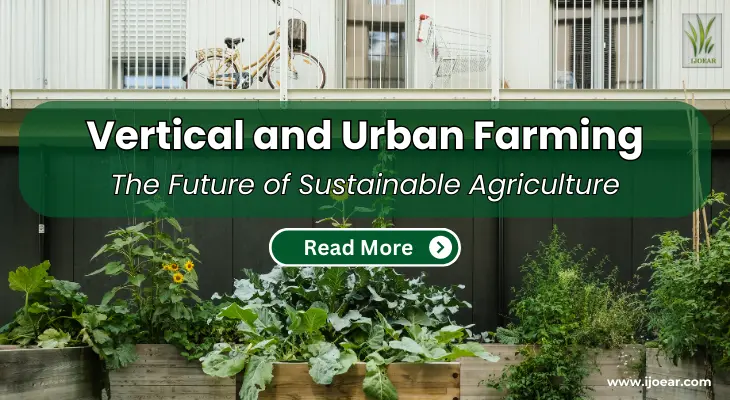
As the world’s population grows and urban spaces expand, traditional farming faces major challenges like land shortages, climate change, and resource depletion. Vertical and urban farming offer innovative solutions to produce fresh food in cities while using minimal space and resources. These farming methods help meet rising food demands while promoting sustainability.
In this blog, we will explore the importance, methods, benefits, challenges, and future of vertical and urban farming.
What is Vertical and Urban Farming?
Vertical Farming
Vertical farming is a modern agricultural technique where crops are grown in stacked layers, often inside buildings, shipping containers, or specially designed vertical structures. It uses controlled environments, hydroponics, aeroponics, and LED lighting to provide optimal conditions for plant growth.
Urban Farming
Urban farming involves growing crops and raising livestock in cities or densely populated areas. This includes rooftop gardens, community farms, hydroponic greenhouses, and small-scale farming operations in urban spaces. It helps utilize unused spaces for food production while promoting local and sustainable agriculture.
Why is Vertical and Urban Farming Important?
- Land Shortage Solutions – With increasing urbanization, farmland is shrinking. Vertical and urban farming make use of unused buildings, rooftops, and indoor spaces to grow food efficiently.
- Climate Change Resilience – Traditional agriculture is highly dependent on weather conditions, but controlled environments in vertical farming protect crops from climate-related challenges like droughts, floods, and temperature fluctuations.
- Food Security in Cities – By growing food closer to consumers, urban and vertical farming reduce dependency on rural farms, ensuring a steady supply of fresh produce.
- Efficient Resource Use – These methods use less land, water, and fertilizers, reducing the environmental footprint of farming.
- Reduction in Food Transportation Costs – Growing food in cities cuts down on long-distance transportation, lowering costs and reducing carbon emissions.
Methods of Vertical and Urban Farming
- Hydroponics – A soilless method where plants grow in nutrient-rich water solutions. It allows faster growth, higher yields, and requires 90% less water than traditional farming.
- Aeroponics – Plants are grown without soil, with nutrient mist sprayed directly onto the roots. This technique improves oxygen absorption and speeds up growth.
- Aquaponics – A combination of hydroponics and fish farming, where fish waste provides nutrients for plants, creating a self-sustaining ecosystem.
- Container Farming – Shipping containers are repurposed into indoor farms with LED lighting, climate control, and hydroponic systems.
- Rooftop and Greenhouse Farming – Utilizing urban rooftops to grow fruits, vegetables, and herbs, often with solar-powered irrigation systems.
Benefits of Vertical and Urban Farming
1. Maximized Space Utilization
Vertical farming stacks plants in multiple layers, producing more food per square meter than traditional farms. Urban farming makes use of vacant lots, rooftops, and indoor spaces.
2. Year-Round Crop Production
With controlled indoor environments, crops can be grown throughout the year, independent of seasonal changes, ensuring a steady food supply.
3. Reduced Water Consumption
Hydroponics and aeroponics use 90-95% less water than soil-based farming by recycling and reusing water efficiently.
4. Pesticide-Free Farming
Since these farms are in enclosed spaces, crops are less exposed to pests and diseases, reducing or eliminating the need for chemical pesticides.
5. Energy Efficiency and Sustainability
LED grow lights provide the optimal light spectrum for plants, reducing energy waste while maximizing photosynthesis. Some farms use solar or wind energy to further reduce their carbon footprint.

6. Job Creation and Community Engagement
Urban farms provide employment opportunities and promote community involvement, encouraging people to grow their own food and support local agriculture.
7. Fresher and Healthier Food
Locally grown food reaches consumers faster and fresher, reducing nutrient loss compared to produce that travels long distances.
Challenges of Vertical and Urban Farming
- High Initial Costs – Setting up vertical farms requires investments in technology, equipment, and climate control systems.
- Energy Consumption – Indoor farming relies on artificial lighting and climate control, which can lead to high electricity usage if not powered by renewable sources.
- Technical Knowledge Requirement – Farmers need training to manage hydroponic and aeroponic systems efficiently.
- Limited Crop Variety – Leafy greens, herbs, and small vegetables thrive in vertical farms, but staple crops like wheat, rice, and corn are harder to cultivate indoors.
- Regulatory and Zoning Issues – Some urban areas have restrictions on farming activities, making it difficult to establish large-scale urban farms.
Future of Vertical and Urban Farming
The demand for sustainable food production is growing, and technological advancements are making vertical and urban farming more efficient and affordable. Future trends include:
- AI and IoT Integration – Smart sensors, AI-driven climate control, and automated irrigation will improve farming efficiency.
- Use of Renewable Energy – Solar and wind energy will make urban farms more eco-friendly.
- Expansion to New Crops – Innovations in plant genetics and growing techniques will allow a wider variety of crops to be grown indoors.
- Urban Policy Support – Governments may introduce subsidies and incentives to promote local and sustainable agriculture.
How IJOEAR Supports Research in Vertical and Urban Farming
The International Journal of Environmental and Agriculture Research (IJOEAR) provides a platform for researchers and agricultural scientists to publish studies on vertical and urban farming. We support:
- Research on hydroponics, aeroponics, and urban farming innovations.
- Open-access publication to make research available globally.
- Peer-reviewed studies ensuring scientific accuracy.
- Collaboration opportunities for experts in smart farming, sustainability, and climate-resilient agriculture.
By publishing with IJOEAR, researchers contribute to the future of sustainable urban food production, helping to solve global food security challenges.
Vertical and urban farming are revolutionizing the way we grow food, offering sustainable, space-efficient, and resource-saving solutions for the future. By adopting innovative technologies and expanding research, we can overcome traditional farming limitations and create a more resilient and food-secure world.
With continued advancements and support from research institutions like IJOEAR, vertical and urban farming will play a crucial role in shaping the future of agriculture.