Why White Grubs Continue to Trouble Farmers Worldwide
White grubs remain one of the most destructive underground agricultural pests, causing serious damage to crops across tropical, subtropical, and temperate farming regions. Despite advances in pest management, these soil-dwelling larvae continue to challenge growers due to their hidden feeding behavior and ability to damage plant roots before symptoms become visible above ground.
In crops ranging from sugarcane and maize to turfgrass, vegetables, fruit orchards, and plantation crops, white grub infestations can severely reduce plant vigor, nutrient uptake, and yield potential. Farmers often notice symptoms such as yellowing leaves, poor growth, wilting, and uneven crop stands without immediately realizing that the problem originates beneath the soil surface.
The difficulty of early detection makes white grub management particularly challenging.
For decades, chemical insecticides dominated grub control strategies. However, growing concerns about pesticide resistance, environmental contamination, soil biodiversity loss, and declining effectiveness have shifted attention toward biological control options. For a broader perspective on sustainable pest management, explore our guide on sustainable pest and disease management.
Today, researchers increasingly focus on biological agents capable of suppressing white grub populations naturally and sustainably. Yet one practical question remains highly relevant for growers: Which biological control agents actually work against white grubs?
The answer lies in understanding white grub biology and identifying biological interventions backed by real-world performance.
Understanding White Grubs and Why They Are Difficult to Control
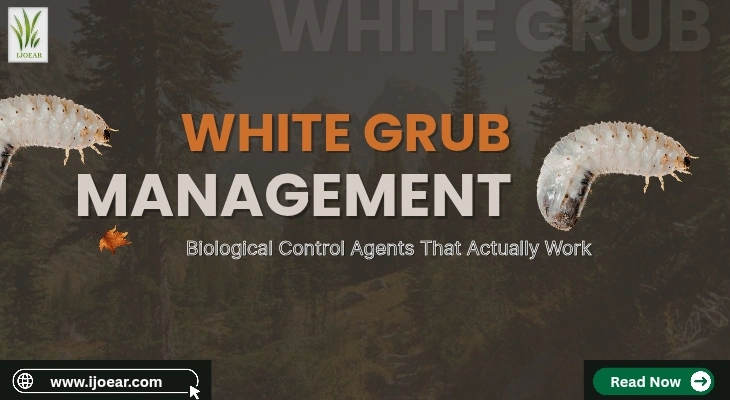
White grubs are the larval stage of scarab beetles belonging to families such as Melolonthinae, Dynastinae, and Rutelinae. These larvae typically appear creamy white with brown heads and curved bodies, spending much of their life underground feeding on plant roots and organic matter.
Their feeding activity often creates substantial economic losses because root damage interferes with water and nutrient absorption.
Common symptoms of infestation include:
- Stunted plant growth
- Yellowing foliage
- Wilting despite adequate irrigation
- Patchy crop establishment
- Reduced root development
- Plant death in severe infestations
One major challenge in controlling white grubs is their underground habitat. Unlike leaf-feeding pests exposed on plant surfaces, white grubs remain hidden in soil, making conventional pesticide application less effective. In many cases, farmers discover infestations only after visible crop damage occurs.
Furthermore, white grub species often have long life cycles, allowing populations to persist in agricultural fields for extended periods. These factors make preventive and biologically supported management increasingly important.

Why Biological Control Is Gaining Attention
Chemical soil insecticides can provide short-term suppression but frequently create unintended ecological problems.
Repeated chemical use may result in soil microbial disruption, harm to earthworms and beneficial organisms, groundwater contamination, resistance development, and increased production costs.
Biological control agents offer a different approach. Rather than relying on toxic compounds, biological interventions use naturally occurring organisms capable of infecting, parasitizing, or suppressing white grub populations. When used correctly, these agents can provide sustainable long-term suppression while preserving soil ecology.
Among the many biological options explored, a few have consistently demonstrated promising results in agricultural systems. For insights on beneficial fungi in pest control, read Beauveria bassiana growth: effect of fungicides on beneficial fungi.
Entomopathogenic Fungi: Nature's Underground Pest Killers
One of the most effective biological solutions for white grub management comes from entomopathogenic fungi. These beneficial fungi infect and kill insect pests naturally by penetrating their outer body surface and multiplying inside the insect.
Several fungal species have shown strong performance against white grubs.
Metarhizium anisopliae
Among biological control agents, Metarhizium anisopliae remains one of the most widely researched fungi for white grub suppression. Once fungal spores contact the grub body, they germinate, penetrate the insect cuticle, and begin internal colonization. Infected larvae gradually weaken and eventually die.
Several studies conducted across agricultural systems report encouraging outcomes using Metarhizium formulations, especially under moist soil conditions.
Researchers often note benefits such as reduced grub survival rates, improved root protection, better long-term suppression, and compatibility with sustainable farming systems.
Environmental conditions significantly influence fungal success. Moisture availability often improves fungal establishment, while extremely dry soils may limit infection efficiency.
Beauveria bassiana
Another widely studied fungal agent, Beauveria bassiana, has demonstrated effectiveness against multiple soil-dwelling pests, including white grubs. Like Metarhizium, this fungus infects larvae through direct contact and internal colonization. Its broad insect host range makes it attractive for integrated pest management systems.
Researchers increasingly view Beauveria bassiana as a complementary biological tool, especially when combined with improved soil management practices. Although fungal control may act more slowly than chemical insecticides, its long-term ecological benefits continue to drive adoption.
Beneficial Nematodes That Hunt White Grubs Underground
Beneficial nematodes represent another highly promising biological control option. Unlike plant-parasitic nematodes that damage crops, entomopathogenic nematodes actively seek out insect pests in soil.
These microscopic organisms enter white grub bodies through natural openings and release symbiotic bacteria that rapidly kill the host.
Two groups receive particular scientific attention.
Steinernema Species
Nematodes belonging to the Steinernema genus are frequently used in soil pest management. Once introduced into the soil, they actively search for insect hosts and can significantly suppress grub populations under suitable environmental conditions.
Benefits often include active host-seeking behavior, reduced non-target effects, and compatibility with organic systems.
Heterorhabditis Species
Heterorhabditis nematodes often demonstrate particularly strong performance against larger soil insects, including white grubs. Some research findings suggest higher effectiveness under deeper soil penetration conditions.
Because these nematodes function underground, soil moisture becomes critically important for movement and survival. Dry soils often reduce their effectiveness considerably.
Bacterial Biocontrol Options Showing Promise
Bacterial agents also contribute to biological white grub management.
Bacillus thuringiensis (Bt)
Although more commonly associated with caterpillar control, certain strains of Bacillus thuringiensis show potential against beetle larvae. These bacteria produce insecticidal proteins that disrupt digestive systems after ingestion. Research outcomes vary depending on grub species and formulation type, but Bt-based approaches continue receiving attention for their environmental safety. For more on microbial biopesticides, see biopesticides for cotton 2026: neem, Bacillus & larval mortality.
Paenibacillus popilliae
Known for causing milky disease in beetle larvae, Paenibacillus popilliae specifically infects scarab grubs. Once ingested, infected larvae develop bacterial symptoms and eventually die. Milky disease has shown notable success in some turf and pasture systems, though performance may vary across climatic conditions and grub species.
Researchers generally view bacterial biocontrol as a valuable supplemental strategy rather than a standalone solution.
Why Soil Health Matters More Than Many Farmers Realize
One overlooked aspect of white grub management is soil ecology. Healthy soils naturally support beneficial microorganisms capable of suppressing pest populations. Excessive chemical use often disrupts microbial balance, unintentionally reducing natural pest suppression mechanisms.
Improving soil health through organic matter incorporation, compost use, reduced chemical disturbance, vermicompost application, and balanced irrigation can indirectly strengthen biological control outcomes.
Researchers increasingly emphasize that successful white grub management depends not only on applying biological agents but also on creating soil environments where these organisms can survive and perform effectively. For more on soil health and carbon sequestration, read carbon sequestration in soils.
Timing Determines Success in Biological White Grub Control
Timing plays a major role in effectiveness. Biological agents often perform best when applied against younger white grub stages rather than mature larvae. Young larvae generally remain more vulnerable and easier to suppress.
Researchers frequently recommend:
- Monitoring Adult Beetle Emergence: Tracking beetle activity helps predict egg-laying periods.
- Early Soil Application: Applying biological agents before severe root damage occurs improves outcomes.
- Moisture Management: Maintaining moderate soil moisture supports fungal and nematode survival.
- Preventive Rather Than Reactive Management: Waiting until visible plant collapse often reduces treatment success.
Biological approaches work best as proactive systems rather than emergency interventions.
Why Some Biological Controls Fail in the Field
Despite strong scientific potential, not all biological programs succeed equally.
Several factors commonly reduce effectiveness:
- Poor Product Quality: Low spore viability or improperly stored formulations can weaken performance.
- Unfavorable Soil Conditions: Extreme dryness or poor organic matter levels may limit survival.
- Incorrect Timing: Late-stage infestations often reduce biological control success.
- Excessive Chemical Use: Certain pesticides may suppress beneficial fungi and nematodes. For insights on fungicide compatibility with beneficial fungi, see Beauveria bassiana and fungicide interactions.
- Unrealistic Expectations: Many growers expect immediate results similar to chemical pesticides. Biological agents often act progressively and require patience.
Understanding these limitations helps improve practical outcomes.
Combining Biological Control Agents for Better Results
Modern research increasingly favors combined biological strategies. Instead of relying on a single control organism, integrated systems may combine entomopathogenic fungi, beneficial nematodes, soil-improving organic amendments, monitoring systems, and limited targeted pesticide use.
For example, combining Metarhizium anisopliae with beneficial nematodes sometimes produces stronger suppression than using either approach alone. These combinations create multiple modes of attack against white grubs.
Researchers continue evaluating compatibility and optimization for commercial farming systems. For more on integrated pest management, explore nature's own pest control: a sustainable revolution in IPM.
Where White Grub Management Is Heading
The future of white grub management increasingly points toward biologically driven systems supported by precision agriculture technologies.
Emerging innovations include AI-assisted pest prediction, improved microbial formulations, long-lasting fungal carriers, nano-enhanced delivery systems, and precision soil treatments.
Scientists also continue searching for region-specific biological agents capable of targeting local grub populations more effectively. As sustainability concerns grow, biological control will likely play an even larger role in underground pest management. For guidance on publishing research in this field, refer to how to publish agriculture research quickly and efficiently.
Building a Smarter Approach to White Grub Control
White grubs remain challenging pests because of their hidden lifestyle and ability to damage crops before farmers detect the problem. Yet growing evidence suggests that effective biological control is not only possible but increasingly practical.
Beneficial fungi such as Metarhizium anisopliae and Beauveria bassiana, along with entomopathogenic nematodes and bacterial agents, offer promising alternatives to heavy chemical dependence.
However, success depends on more than simply applying a product. Timing, soil conditions, moisture, monitoring, and ecosystem health all influence outcomes.
For growers seeking long-term and environmentally responsible white grub management, biological control agents that actually work are those supported by smart implementation and integrated farming practices rather than one-time interventions alone.
Continue Exploring: Recommended Reads from IJOEAR and AD Publications Blog
📚 You may also find these articles valuable for your research and academic writing journey:
- Sustainable Pest and Disease Management — Comprehensive strategies for eco-friendly pest control across cropping systems.
- Beauveria Bassiana Growth: Effect of Fungicides on Beneficial Fungi — Understand fungicide compatibility with beneficial soil fungi.
- Biopesticides for Cotton 2026: Neem, Bacillus & Larval Mortality — Discover microbial biopesticides for effective pest control.
- Nature's Own Pest Control: A Sustainable Revolution in IPM — Explore biological and ecological approaches to pest suppression.
- Chemical vs. Biological Pest Control: 2026 Efficacy Data for Cotton — Understand the efficacy comparison between chemical and biological methods.
- How to Use Zotero for Citation — Learn to manage references and citations efficiently for your research papers.
- How to Write a Research Paper for a Scopus Journal — Get expert guidance on publishing in high-impact journals.