
International Journal of
Environmental & Agriculture Research
ISSN No. 2454-1850 | R Impact Factor 4.38 | NAAS Rating 4.23


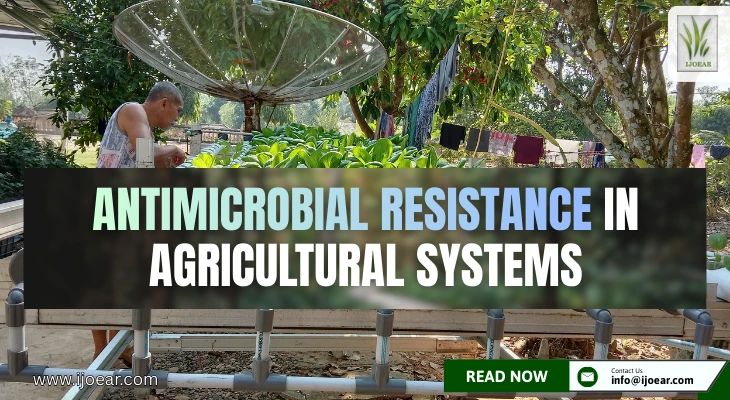
Antimicrobial resistance (AMR) is one of the most intricate ecological and public health problems of the twenty-first century. While widely discussed in clinical contexts, the agribusiness sector is now critically recognized as a primary arena where resistance emerges, propagates, and spreads across human, animal, and environmental boundaries. Intensive livestock production, aquaculture, crop cultivation, and soil management are key drivers increasing the global reservoir of resistant bacteria and resistance genes. This blog synthesizes scientific monographs, global surveillance reports, and original research to provide an integrative, analytical perspective for advanced scholars on AMR mechanisms, pathways, drivers, and mitigation strategies within agricultural systems.
The use of antimicrobials in agriculture began soon after their discovery. In the 1940s–1950s, researchers found that subtherapeutic doses of tetracycline and penicillin could promote livestock growth. This led to widespread application in poultry, swine, and cattle production, especially as industrial-scale concentrated animal feeding operations (CAFOs) expanded. By the 1960s, agricultural antibiotics constituted a significant portion of total antimicrobial use in many nations.
Concurrently, plant agriculture began using antibacterial and antifungal compounds. Streptomycin and oxytetracycline became common treatments for bacterial diseases in high-value crops like apples and citrus. Aquaculture, particularly in East Asia and South America, adopted broad-spectrum antibiotics to manage outbreaks in high-density fish farms. This decades-long, continuous selective pressure has accelerated bacterial adaptation.
Modern scholarship increasingly frames agricultural AMR within the One Health paradigm, recognizing the interconnectedness of human, animal, and environmental health. Agroecosystems host diverse microbial communities in soil, water, plant surfaces, animal guts, and waste products. These environments serve as reservoirs for resistance genes (the resistome), which can be exchanged via horizontal gene transfer.
This approach treats AMR not as an isolated phenomenon but as an ecological and evolutionary process influenced by selective forces, gene flow, and microbial interactions. Pathways such as livestock manure, aquaculture effluents, and irrigation water create interconnected systems where resistant strains can circulate. This ecological framing is essential for advanced research, shifting focus from individual pathways to systemic interactions.
Scientific literature categorizes three primary mechanisms driving resistance in agricultural settings:
Intensive livestock production remains one of the most researched contributors to agricultural AMR. High stocking densities and disease susceptibility have historically driven the use of antibiotics for growth promotion and prophylaxis. Despite regulatory restrictions on growth promoters in many regions, therapeutic and metaphylactic use remains high.
As a rapidly expanding food sector, aquaculture is a major global antimicrobial consumer. High-density farming predisposes fish to bacterial pathogens (Aeromonas, Vibrio, Flavobacterium). The aquatic environment facilitates rapid dispersal.

While using fewer antibiotics than animal agriculture, plant farming creates localized resistance hotspots. Streptomycin and oxytetracycline are sprayed on orchards to control fire blight, while copper-based compounds combat fungal and bacterial diseases. Recurrent use selects for resistant strains of Erwinia and Pseudomonas.
Crucially, plant systems connect to broader resistance ecology via manure amendments, pesticide mixtures, and irrigation with contaminated water. The rhizosphere becomes a dynamic interface for microbial interaction and gene transfer.
Soil microbiomes are naturally rich in intrinsic resistance genes. Anthropogenic inputs (manure, biosolids, wastewater) amplify this by adding resistant bacteria and antimicrobial residues.
Water is a key transmission pathway. Runoff, leaching, aquaculture effluents, and wastewater introduce antibiotics and resistant bacteria into rivers, lakes, and groundwater.
Agricultural waste streams (manure, bedding, aquaculture sludge, slaughterhouse effluent) are concentrated sources of resistant bacteria.
Agricultural AMR impacts human health through direct and indirect routes:
Advanced tools are revolutionizing AMR research:
International guidelines (WHO Global Action Plan, OIE Terrestrial Animal Health Code, FAO Action Plan) promote prudent use, enhanced surveillance, and restrictions on growth-promoting applications. National regulations vary, with the EU implementing a broad ban on growth promoters in 2006, while other regions still exhibit high therapeutic use.
A multidimensional approach is required:
Future work must adopt a systems-level perspective, integrating ecological, molecular, technological, and socioeconomic dimensions. Key frontiers include:
For PhD candidates, agricultural antimicrobial resistance (AMR) offers a rich field for high-impact, interdisciplinary research. Here are condensed, actionable research avenues:
Core Methodological Advantage: A strong PhD will bridge scales—connecting molecular data to field observations to human outcomes. Using tools like agent-based modeling, longitudinal field studies, or randomized controlled trials on farms can provide this crucial integration. For those interested in pursuing a PhD in agriculture, understanding these interdisciplinary approaches is crucial.
AMR in agricultural systems is a profound interdisciplinary challenge. The intricate connections between soil, water, animals, crops, and humans create a dynamic landscape for resistance evolution and spread. For advanced scholars, this field offers rich opportunities for research that bridges microbiology, environmental science, veterinary medicine, and policy. The path forward requires not just reduced antibiotic use, but a fundamental rethinking of agricultural practices through the integrative lens of One Health, guided by rigorous science and sustained global cooperation.
1. What is agricultural antimicrobial resistance?
Ans. : It is the reduced efficacy of antimicrobial agents used in farming due to the evolution and spread of resistant microorganisms in animals, crops, and associated environments (soil, water). Agricultural systems act as major amplifiers and reservoirs of resistance genes.
2. Why is agricultural antibiotic use a major global concern?
Ans. : The scale, duration, and often sub-therapeutic nature of use exert immense selective pressure. Residues persist in the environment, maintaining selection long after use ceases, and high-density farming facilitates rapid microbial gene exchange.
3. How do resistance genes move through agricultural environments?
Ans. : Primarily via horizontal gene transfer (conjugation, transduction, transformation) on mobile genetic elements. Physical pathways include runoff, irrigation water, manure application, and airborne dust.
4. Why are environmental reservoirs (soil, water) so important?
Ans. : They act as long-term storage sites for resistance genes, maintaining a "genetic memory" that can repopulate systems even after antibiotic use is reduced. They are mixing points for diverse microbial communities.
5. How does climate change interact with agricultural AMR?
Ans. : Altered temperatures and precipitation patterns can increase bacterial growth rates, disease incidence, and the runoff of contaminants, potentially accelerating resistance selection and dispersal.
6. What is microbiome engineering's potential role?
Ans. : It involves designing microbial communities (e.g., in gut or soil) to suppress pathogens, degrade antibiotic residues, or interfere with gene transfer—offering a proactive ecological intervention.
7. Why is genomic surveillance critical?
Ans. : Techniques like metagenomics and whole-genome sequencing allow for the early detection of emerging resistance threats, tracking of transmission routes, and assessment of intervention impacts at a genetic level.
8. How do socioeconomic factors influence AMR in agriculture?
Ans. : Farmer decisions are driven by economics, access to veterinary services, market demands, and cultural practices. Effective stewardship must address these real-world drivers.
9. What disciplines are needed to solve this problem?
Ans. : A truly interdisciplinary effort is required, integrating microbiology, ecology, veterinary science, agronomy, economics, social science, and public policy under a One Health framework.
10. What are the most promising research frontiers?
Ans. : Evolutionary predictive modeling, advanced environmental surveillance, microbiome engineering, AI-driven farm management, and practical One Health implementation research.
 NAAS Rating: 4.23
  December 2025 Issue
R Impact Factor: 4.38
Submit Article
December 2025 Issue
R Impact Factor: 4.38
Submit Article
|
Citation Indices
|
All
|
Since 2020
|
|
Citation
|
6164
|
5117
|
|
h-index
|
31
|
29
|
|
i10-index
|
201
|
165
|
|
Acceptance Rate (By Year)
|
|
|
Year
|
Percentage
|
|
2024
|
11.09%
|
|
2023
|
15.23%
|
|
2022
|
12.81%
|
|
2021
|
10.45%
|
|
2020
|
9.6%
|
|
2019
|
14.3%
|
|
2018
|
17.65%
|
|
2017
|
16.9%
|
|
2016
|
22.9%
|
|
2015
|
26.1%
|
Contact Information
Address: 12/421, MP Nagar, Bikaner, INDIA. PIN: 334004
Frequency: 12 issue per year
Email: info@ijoear.com
Email: info.ijoear@gmail.com
Website: https://ijoear.com/
 This work is licensed under a Creative Commons Attribution 4.0 International License.