Rising Pest Pressure in Cotton and the Shift Toward Biocontrol
Cotton cultivation continues to face intense pest pressure across major producing regions, especially from lepidopteran larvae such as bollworms and armyworms. In 2026, increasing resistance to chemical insecticides, environmental concerns, and residue regulations have accelerated the adoption of biopesticides as a core pest management strategy.
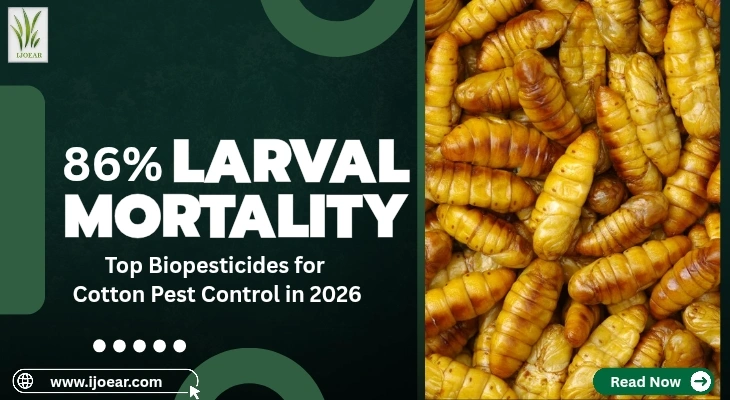
One of the most promising developments in recent research and field trials is the reported up to 86% larval mortality achieved through integrated biopesticide applications under optimal conditions. This marks a major shift from purely chemical control to eco-friendly, resistance-safe pest management systems.
Biopesticides are now central to sustainable cotton production, combining microbial agents, botanical extracts, and entomopathogenic organisms to suppress pest populations effectively. For a comprehensive understanding of biopesticides in cotton, explore our guide on biopesticides for cotton 2026: neem, Bacillus & larval mortality.
Understanding Larval Pests in Cotton Ecosystems
Cotton crops are highly vulnerable to insect infestations throughout their growth cycle.
Major larval pests include:
- Bollworms (American, Pink, and Spotted)
- Armyworms
- Leaf-eating caterpillars
- Cutworms
Damage caused:
- Leaf defoliation
- Flower and square drop
- Boll damage and yield loss
- Reduced fiber quality
Larval stages are particularly destructive because of their high feeding activity, making early intervention critical. For more on sustainable pest management, read sustainable pest and disease management.
What Are Biopesticides?
Biopesticides are natural or biologically derived pest control agents that target specific insect pests without harming beneficial organisms or the environment.
Types of biopesticides:
- Microbial biopesticides (bacteria, fungi, viruses)
- Botanical biopesticides (plant-based extracts)
- Entomopathogenic organisms (insect-parasitic fungi/nematodes)
Unlike synthetic pesticides, biopesticides work through infection, growth inhibition, or behavioral disruption rather than chemical toxicity.

Bacillus thuringiensis (Bt): The Backbone of Cotton Biocontrol
One of the most widely used biopesticides in cotton pest management is Bacillus thuringiensis (Bt).
How Bt works:
- Produces crystalline proteins toxic to larval gut systems
- Causes feeding cessation and gut paralysis
- Leads to larval death within days
Advantages:
- Highly specific to target pests
- Safe for humans, pollinators, and beneficial insects
- Compatible with integrated pest management (IPM)
Bt formulations are a key reason behind high larval mortality rates in modern cotton systems. For insights on nature-based pest control, see nature's own pest control: a sustainable revolution in IPM.
Nuclear Polyhedrosis Virus (NPV) in Pest Control
NPV-based biopesticides are highly effective against lepidopteran larvae.
Mode of action:
- Virus enters larval body through ingestion
- Replicates inside host cells
- Causes systemic infection and death
Benefits:
- Extremely host-specific
- Environmentally safe
- Effective in early larval stages
NPV is especially useful in controlling armyworm and bollworm populations when applied at the right growth stage.
Beauveria bassiana: Fungal Bioinsecticide
Beauveria bassiana is a widely used entomopathogenic fungus in cotton pest management.
Mechanism:
- Spores attach to insect cuticle
- Germinate and penetrate body
- Release toxins leading to death
Strengths:
- Works on multiple pest species
- Effective under humid conditions
- Suitable for integrated pest management
It is often used in combination with other biopesticides to enhance larval mortality rates.
Neem-Based Biopesticides (Azadirachtin)
Neem-derived products are among the most important botanical biopesticides.
Active compound: Azadirachtin
Effects on larvae:
- Feeding deterrence
- Growth regulation
- Disruption of molting process
- Reduced reproduction
Advantages:
- Readily available and cost-effective
- Low environmental impact
- Compatible with other biocontrol agents
Neem-based formulations are widely used in cotton IPM programs.
Integrated Biopesticide Strategy for 86% Larval Mortality
High larval mortality rates (up to 86%) are typically achieved through combination strategies, not single applications.
Effective integration includes:
- Bt + NPV for early larval stages
- Beauveria bassiana for extended control
- Neem formulations for growth regulation
- Timely application based on pest monitoring
Key success factors:
- Early detection of infestation
- Correct dosage and timing
- Proper field humidity and temperature
- Rotation of biocontrol agents
Integration prevents resistance buildup and enhances long-term effectiveness. For more on resistance management in agriculture, read antimicrobial resistance in agricultural systems.
Role of IPM (Integrated Pest Management)
Biopesticides are most effective when used within an IPM framework.
IPM components include:
- Pest monitoring using pheromone traps
- Threshold-based spraying decisions
- Use of resistant cotton varieties
- Conservation of natural predators
- Minimal chemical pesticide use
IPM ensures sustainable pest control without ecological imbalance.
Environmental Benefits of Biopesticides
The shift toward biopesticides in cotton farming brings multiple environmental advantages:
- Reduced chemical residue in soil and water
- Protection of pollinators and beneficial insects
- Improved soil microbial health
- Lower risk of pest resistance development
- Enhanced biodiversity in agroecosystems
These benefits align with global sustainability goals in agriculture. For a broader perspective on sustainable farming trends, explore the future of sustainable farming: trends and challenges.
Challenges in Biopesticide Adoption
Despite their advantages, several challenges remain:
- Slower action compared to chemical pesticides
- Sensitivity to environmental conditions
- Limited shelf life of some formulations
- Need for proper farmer training
- Inconsistent field performance under stress conditions
Addressing these challenges requires better formulation technology and extension services.
Future of Biopesticides in Cotton Farming
In 2026, biopesticide technology is rapidly evolving.
Emerging trends include:
- Nano-formulated biopesticides for better stability
- AI-based pest forecasting systems
- Gene-based microbial enhancements
- Drone-assisted biopesticide spraying
- Precision IPM platforms
These innovations aim to increase efficacy while maintaining ecological safety. For guidance on publishing research in biocontrol, refer to how to publish agriculture research quickly and efficiently.
Sustainable Pest Control for High-Yield Cotton Production
Achieving high larval mortality in cotton using biopesticides reflects a broader shift toward sustainable agriculture. With effective integration of microbial, botanical, and viral agents, farmers can achieve strong pest suppression while protecting environmental health.
In 2026, biopesticides are no longer alternative solutions—they are becoming central tools in modern cotton pest management systems, ensuring productivity, resilience, and sustainability.
Continue Exploring: Recommended Reads from IJOEAR Blog
📚 You may also find these articles valuable for your research and sustainable agriculture practice:
- Biopesticides for Cotton 2026: Neem, Bacillus & Larval Mortality — Deep dive into neem-based and microbial biopesticides for cotton pest control.
- Sustainable Pest and Disease Management — Comprehensive strategies for eco-friendly pest control across cropping systems.
- Nature's Own Pest Control: A Sustainable Revolution in IPM — Explore biological and ecological approaches to pest suppression.
- Antimicrobial Resistance in Agricultural Systems — Understand resistance dynamics and sustainable alternatives for crop protection.
- Agri-Robotics 2025: Autonomous Machines Transforming Modern Agriculture — Discover how automation and AI are reshaping precision pest management.