The Growing Need for Smarter Cotton Pest Management
Cotton farming in 2026 is increasingly shaped by resistance issues, residue concerns, and environmental sustainability goals. Traditional chemical pesticides are losing effectiveness against key pests like bollworms and armyworms, pushing farmers toward biopesticides as a reliable alternative.
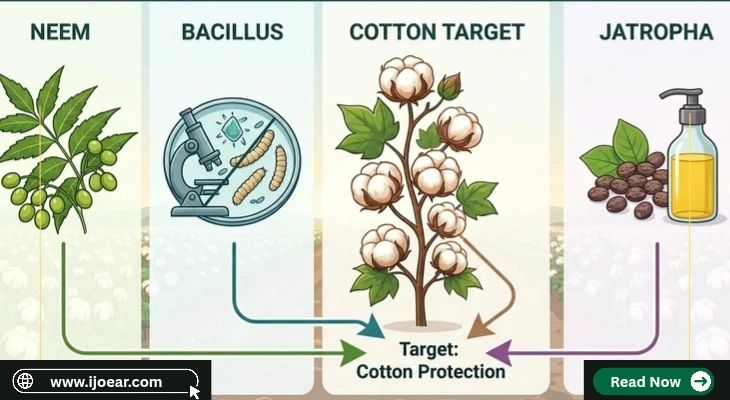
Among the most widely used biopesticide options in cotton systems are neem-based formulations, Bacillus thuringiensis (Bt), and Jatropha-derived extracts. Each offers a different mode of action, level of effectiveness, and suitability for pest control.
Understanding how these three compare is essential for building an efficient, sustainable Integrated Pest Management (IPM) strategy. For a comprehensive overview of biopesticides in cotton, explore our guide on biopesticides for cotton 2026: neem, Bacillus & larval mortality.
Understanding the Three Biopesticide Options
Neem-Based Biopesticides
Neem products are derived from the seeds and leaves of the neem tree, rich in azadirachtin, a natural insect growth regulator.
Bacillus thuringiensis (Bt)
Bt is a soil-dwelling bacterium that produces crystal proteins toxic to specific insect larvae when ingested.
Jatropha-Based Biopesticides
Jatropha extracts contain bioactive compounds with insecticidal and anti-feedant properties, though they are less standardized compared to neem and Bt.
Each of these biopesticides works differently, targeting pests through distinct biological pathways. For more on sustainable pest management, read sustainable pest and disease management.
Mode of Action Comparison
Neem: Growth and Feeding Disruption
Neem does not kill pests instantly. Instead, it disrupts insect hormonal balance, inhibits molting and growth, reduces feeding activity, and impairs reproduction.
Bacillus thuringiensis (Bt): Gut Toxicity
Bt acts more directly: ingested by larvae, toxins damage gut lining, causing feeding cessation and death. It is highly specific to caterpillar pests.
Jatropha: Neurotoxic and Anti-Feedant Effects
Jatropha works through feeding deterrence, disruption of insect metabolism, mild toxic effects on larvae, with variable efficacy depending on formulation.

Effectiveness Against Cotton Pests
Neem-Based Biopesticides
Moderate effectiveness, best for early-stage pest suppression, strong anti-feedant properties, works well in combination strategies.
Bacillus thuringiensis (Bt)
High effectiveness against bollworms and armyworms, best larval mortality rates among the three, works quickly under proper conditions, most reliable for targeted pest outbreaks. For detailed larval mortality data, see 86% larval mortality: top biopesticides for cotton.
Jatropha-Based Extracts
Variable and region-dependent effectiveness, better as a supplementary control agent, less consistent in large-scale commercial farming, still under research and optimization.
Speed of Action
- Bt: Fast (2–5 days after ingestion)
- Neem: Slow to moderate (affects growth cycle)
- Jatropha: Moderate but inconsistent
Bt clearly outperforms in rapid pest knockdown, while neem focuses on long-term population suppression.
Environmental and Ecological Impact
Neem: Highly eco-friendly, safe for beneficial insects, widely accepted in organic farming.
Bt: Extremely specific to target pests, no harm to pollinators or natural predators, considered one of the safest microbial pesticides. For insights on nature-based pest control, explore nature's own pest control: a sustainable revolution in IPM.
Jatropha: Natural origin but less studied, potential toxicity variability, ecological impact depends on extraction method.
All three are significantly safer than chemical pesticides, but Bt and neem are more scientifically validated.
Role in Integrated Pest Management (IPM)
Rather than competing, these biopesticides are most effective when used together.
Effective IPM combinations:
- Bt for rapid larval control
- Neem for growth regulation and prevention
- Jatropha as a supplementary deterrent
This layered approach helps prevent pest resistance, improve long-term control, and reduce chemical pesticide dependency.
Field Performance in Cotton Systems
Bt Performance: Highest consistency in field trials, strong control of bollworms, best suited for outbreak situations.
Neem Performance: Excellent preventive control, works best in early infestation stages, improves overall crop resilience.
Jatropha Performance: Mixed results in field conditions, useful in low to moderate pest pressure zones, requires further standardization.
Cost and Accessibility
- Neem: Widely available and cost-effective
- Bt: Moderately priced but high value due to effectiveness
- Jatropha: Low cost but limited commercial formulation availability
Neem remains the most accessible, while Bt offers the best cost-to-performance ratio in intensive cotton farming.
Limitations of Each Biopesticide
Neem: Slow action, requires repeated applications.
Bt: Ineffective against non-larval pests, sensitive to UV degradation.
Jatropha: Lack of standardized dosage, inconsistent field results.
Understanding these limitations is crucial for proper field planning.
Which Works Best for Cotton?
There is no single "best" biopesticide for all conditions. However:
- Bt is the most effective for direct larval mortality
- Neem is the best for preventive and long-term pest suppression
- Jatropha is best as a supplementary or experimental option
The most successful cotton pest management systems in 2026 rely on integration rather than substitution. For more on resistance management, read antimicrobial resistance in agricultural systems.
Future of Biopesticide Use in Cotton
Biopesticide technology is evolving rapidly with:
- Nano-formulated neem and Bt products
- AI-based pest monitoring systems
- Improved microbial strain engineering
- Precision spray technologies
- Climate-adaptive biopesticide formulations
These advancements will further improve efficacy and reduce application frequency. For guidance on publishing research in this field, refer to how to publish agriculture research quickly and efficiently.
Building a Balanced Biopesticide Strategy
Neem, Bacillus thuringiensis, and Jatropha each contribute differently to cotton pest control. Instead of choosing one, modern agriculture emphasizes combining their strengths within IPM systems.
In 2026, sustainable cotton production depends on this integrated approach—balancing effectiveness, environmental safety, and economic viability to achieve long-term pest control success.
Continue Exploring: Recommended Reads from IJOEAR Blog
📚 You may also find these articles valuable for your research and sustainable agriculture practice:
- Biopesticides for Cotton 2026: Neem, Bacillus & Larval Mortality — Deep dive into neem-based and microbial biopesticides for cotton pest control.
- 86% Larval Mortality: Top Biopesticides for Cotton Pest Control in 2026 — Explore integrated biopesticide strategies achieving high larval mortality rates.
- Sustainable Pest and Disease Management — Comprehensive strategies for eco-friendly pest control across cropping systems.
- Nature's Own Pest Control: A Sustainable Revolution in IPM — Explore biological and ecological approaches to pest suppression.
- Agri-Robotics 2025: Autonomous Machines Transforming Modern Agriculture — Discover how automation and AI are reshaping precision pest management.