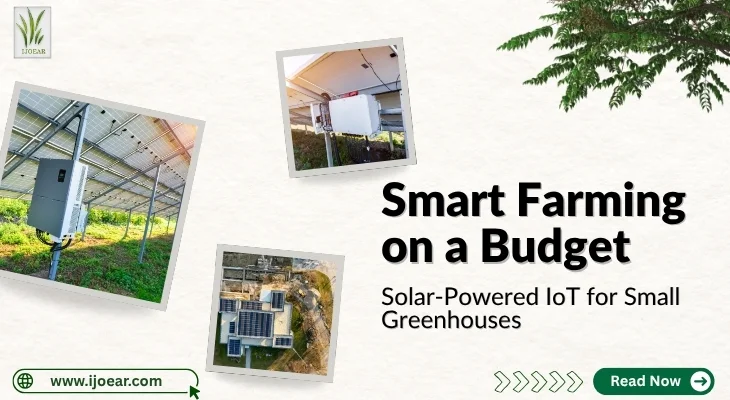
Smart farming is often associated with expensive machinery, sophisticated software, and large commercial farms. But that picture is changing.
A small greenhouse does not need a huge investment to become smarter. With a modest solar panel, a few sensors, a small controller, and an efficient irrigation system, growers can begin monitoring their crops and automating routine tasks without building a complicated high-tech farm.
This is where solar-powered IoT for small greenhouses becomes particularly useful. For a broader perspective on smart farming technologies, explore our guide on IoT and sensor networks in smart farming automation and future research.
The basic idea is simple: sensors collect information about the growing environment, an IoT controller processes that information, and selected equipment responds when action is needed. Solar energy can provide electricity for the electronics and, depending on the system design, small pumps and other low-power equipment.
For small growers, the goal should not be to automate everything. The better strategy is to automate the tasks that consume the most time, water, or electricity while keeping the system simple enough to maintain.
What Is Solar-Powered IoT Farming?
IoT, or the Internet of Things, refers to connected devices that collect and exchange data.
In a greenhouse, this might mean sensors measuring:
- Soil moisture
- Air temperature
- Relative humidity
- Light intensity
- Water-tank level
- Soil temperature
A small microcontroller, such as an ESP32-based board, can collect readings from these sensors. The information can then be displayed on a phone, dashboard, or messaging platform.
The controller can also trigger equipment.
For example, imagine that the soil moisture level falls below a predetermined threshold. Instead of waiting for the farmer to inspect every plant, the system can activate a small irrigation pump or valve.
Low-cost IoT greenhouse systems are already being demonstrated in smallholder settings. FAO's AgriTech Observatory describes a greenhouse initiative in Uzbekistan where sensors costing less than US$100 were assembled using open-source technologies. The system monitored temperature, humidity, soil moisture, and light and allowed farmers to control drip irrigation.
That example illustrates an important point: smart farming does not necessarily require expensive commercial automation equipment.
Why Add Solar Power?
IoT equipment needs electricity, but a small greenhouse may not have convenient access to a reliable power supply.
Solar energy can solve part of this problem.
A basic solar setup can include:
Solar panel → charge controller → battery → IoT controller and equipment
During daylight, the solar panel produces electricity. The charge controller manages charging, while the battery stores energy for periods when sunlight is weak or unavailable.
The U.S. Department of Energy explains that energy storage can complement solar because solar production does not always occur at the same time electricity is needed.
For a greenhouse, this matters because monitoring and control may need to continue during cloudy periods, nighttime, or early morning.
However, solar should not be treated as unlimited free electricity. The panel, battery, pump, sensors, and controller all need to be sized according to actual energy requirements. For more on renewable energy in agriculture, read renewable energy and sustainability for a better future.

The Budget-Friendly Approach: Start Small
One of the biggest mistakes in smart farming is trying to automate an entire greenhouse from day one.
A better approach is to build the system in stages.
Stage 1: Monitor the Soil
Start with a reliable soil-moisture sensor.
The purpose is not simply to display a number on a phone. The real objective is to answer a practical question:
Does the crop actually need water right now?
This can help replace guesswork with measured information.
Stage 2: Monitor Temperature and Humidity
Add an air-temperature and humidity sensor.
Greenhouse conditions can change considerably during the day. Monitoring these variables gives the grower a clearer picture of what is happening inside the structure.
Temperature and humidity data can also help explain crop stress that might otherwise be blamed on irrigation.
Stage 3: Automate Irrigation
Once the monitoring system is reliable, connect it to a small pump, solenoid valve, or other suitable irrigation control.
The system can be programmed to operate only when soil moisture reaches a selected threshold.
Drip irrigation is particularly useful because water can be delivered close to the plant's root zone rather than being distributed indiscriminately.
FAO notes that better irrigation scheduling helps ensure water is applied in the right amount and at the right time. For more on water management, see water conservation and smart irrigation systems.
Stage 4: Add Alerts
A notification can be more valuable than a complicated dashboard.
For example, the farmer could receive an alert when:
- Soil moisture becomes unusually low
- Greenhouse temperature crosses a selected limit
- The water tank is nearly empty
- The battery voltage becomes too low
- A sensor stops reporting data
This turns IoT into a practical farming assistant rather than another screen that needs constant attention.
What Does a Low-Cost Smart Greenhouse Need?
A simple system can be assembled from several basic components.
| Component | Main purpose |
|---|---|
| Solar panel | Produces electricity |
| Charge controller | Manages battery charging |
| Battery | Stores energy |
| Microcontroller | Processes sensor information |
| Soil-moisture sensor | Estimates moisture around the crop |
| Temperature/humidity sensor | Tracks greenhouse climate |
| Water-level sensor | Monitors irrigation supply |
| Relay or suitable driver | Controls electrical equipment |
| Pump or valve | Delivers irrigation water |
| Drip lines | Distribute water to plants |
| Connectivity | Sends data or alerts |
Not every greenhouse needs every component.
For a small operation, the most sensible starting combination may be:
Solar power + battery + microcontroller + soil-moisture sensor + temperature/humidity sensor + drip irrigation.
Additional sensors can be introduced later.
How the System Works in Real Life
Consider a small greenhouse growing tomatoes.
At 7 a.m., the solar panel begins producing energy. The controller checks the battery and starts collecting environmental readings.
The soil-moisture sensor reports that the growing medium is sufficiently moist, so irrigation remains off.
At midday, the greenhouse becomes warmer. The temperature sensor records the change.
Several hours later, soil moisture falls below the chosen irrigation threshold. The controller activates the pump for a predetermined period.
Water travels through the drip lines and reaches the plants.
The sensor checks the moisture condition again. If the target level has been reached, the pump stops.
Meanwhile, the system can send the day's measurements to the farmer's phone.
The farmer does not need to stand beside the greenhouse to perform every routine check.
This is the practical value of IoT: it turns measurements into timely decisions.
How Much Can a Small System Cost?
The cost depends heavily on local suppliers, greenhouse size, crop requirements, solar conditions, pump capacity, connectivity, and the quality of the components.
Instead of promising a fixed price, it is more useful to think in terms of a modular budget.
Basic monitoring system
A very small greenhouse could begin with:
- One microcontroller
- One soil-moisture sensor
- One temperature/humidity sensor
- Small solar panel
- Battery
- Basic wiring and enclosure
This provides monitoring without automatic irrigation.
Monitoring plus irrigation
The next level adds:
- Small DC water pump
- Relay or motor driver
- Drip lines
- Water tank
- Additional plumbing
Now the system can make irrigation decisions rather than simply report conditions.
More advanced setup
A larger installation might include:
- Multiple moisture sensors
- Multiple irrigation zones
- Water-level monitoring
- Light sensors
- Ventilation control
- Remote dashboard
- Cellular or Wi-Fi connectivity
- Larger battery storage
- Backup power
The important lesson is that a farmer does not need the advanced version to benefit from smart farming.
In fact, a smaller and simpler system may be easier to troubleshoot.
Choosing the Right Solar Panel
Solar panel sizing should begin with the electrical load rather than an arbitrary panel size.
Make a list of everything that will consume electricity:
- IoT controller
- Sensors
- Communication module
- Pump
- Valves
- Fans
- Other accessories
The pump may become the largest energy consumer, particularly if it runs frequently.
Suppose the electronics consume very little energy but the pump operates several times a day. Designing the solar system around the electronics alone would be a mistake.
A simple energy calculation can be expressed as:
Daily energy requirement = power consumption × operating time
For example, a 20-watt device operating for two hours uses:
20 W × 2 hours = 40 Wh
Perform this calculation for the major loads and add a reasonable margin for system losses and less-than-ideal solar conditions.
The final solar and battery size should ideally be determined using local sunlight conditions and the desired backup period.
Battery Storage Matters
A solar panel produces electricity when sunlight is available. A greenhouse system, however, may need electricity after sunset or during cloudy weather.
That is why battery storage can be important.
The battery does not have to power a large farm. For a small monitoring system, the electrical load may be relatively modest. But if the same battery is expected to run a pump, fan, lighting system, and communication equipment, its required capacity increases.
This creates an important budgeting principle:
Reduce electricity demand before buying a larger solar system.
Using efficient DC equipment, avoiding unnecessary continuous operation, and running pumps only when needed can reduce the size and cost of the energy system.
Smart Irrigation Is Often the Best First Automation
If the budget is limited, irrigation is one of the strongest candidates for automation.
Why?
Because irrigation decisions directly affect both water use and plant health.
Traditional watering may follow a fixed routine:
"Water the greenhouse every morning."
But crop water requirements do not necessarily remain identical every day.
Weather, plant size, growing medium, greenhouse temperature, and crop stage can all influence water requirements.
A sensor-based approach can instead ask:
"What does the growing medium need right now?"
Recent research has continued to investigate solar-powered IoT irrigation systems using microcontrollers, soil-moisture sensors, temperature/humidity sensors, batteries, and automated pump control.
A 2026 study of a solar-powered IoT drip-irrigation system for greenhouse tomatoes reported lower water and energy use under its sensor-based control strategy, although results from individual research systems should not be treated as guaranteed savings for every farm.
That distinction is important.
IoT can improve decision-making, but the actual savings depend on system design and farm management. For related insights, read latest research on low-water precision irrigation systems.
Don't Ignore the Water Source
Solar-powered irrigation sounds sustainable, but solar electricity does not automatically make water use sustainable.
If a pump makes it cheaper and easier to extract groundwater, farmers could potentially use more water than before.
FAO specifically highlights this concern: solar-powered irrigation can reduce operating costs and improve water access, but it also needs proper management to avoid waste and unsustainable groundwater abstraction.
For a small greenhouse, a better strategy may be to combine:
Solar energy + water storage + drip irrigation + soil-moisture monitoring.
The objective is not simply to pump more water.
The objective is to use the available water more intelligently.
A Practical Example for a Small Greenhouse
Imagine a grower with a 100–200 square metre greenhouse.
Instead of purchasing a complete commercial automation package, the grower could build a basic system around five functions:
- Measure soil moisture.
- Measure temperature and humidity.
- Monitor the water tank.
- Operate a small irrigation pump.
- Send alerts to a phone.
The farmer can then create simple rules.
For example:
If soil moisture falls below the selected threshold → check whether the water tank contains enough water → activate irrigation → stop the pump after the target duration → measure again.
The exact thresholds should be determined according to the crop, growing medium, sensor characteristics, and local conditions rather than copied blindly from another greenhouse.
This is an important principle of affordable smart farming:
Use technology to support agricultural knowledge, not replace it.
Where IoT Can Save Money
The financial benefits of a smart greenhouse can come from several areas.
1. Less unnecessary irrigation
If the system prevents watering when moisture is already adequate, water and pumping energy may be saved.
2. Less manual monitoring
The farmer can receive readings remotely rather than repeatedly visiting the greenhouse simply to check basic conditions.
3. Faster response to problems
An alert about an empty tank, excessive temperature, or low battery can allow the farmer to respond before the problem becomes more serious.
4. Better record keeping
Historical sensor data can reveal patterns.
A grower might discover that the greenhouse consistently becomes too warm during a certain period or that a particular crop bed dries faster than another.
5. Lower dependence on grid electricity
Where grid power is unreliable or unavailable, a correctly sized solar system can provide energy independence for selected low-power tasks.
FAO has identified solar-powered irrigation as a potentially affordable option for smallholder farmers, while also emphasizing the need to consider system configuration, water storage, pumping conditions, soil, and other site-specific factors.
What About Internet Connectivity?
An IoT greenhouse does not necessarily need expensive broadband.
Depending on the location, connectivity could come from:
- Wi-Fi
- Cellular data
- LoRa-based communication
- Local radio communication
- A gateway connected to the internet
For a greenhouse located close to a home or farm office, Wi-Fi may be enough.
For a remote field, cellular or another long-range communication method may be more appropriate.
The technology should follow the farm's circumstances—not the other way around.
Common Mistakes to Avoid
Buying too many sensors
More sensors do not automatically mean better farming.
Start with measurements that can lead to useful decisions.
Using poor-quality moisture sensors
A sensor that produces unstable or misleading readings can cause automated irrigation to behave badly.
Choose sensors carefully and test them before relying on them for automatic control.
Putting electronics in a humid environment without protection
Greenhouses contain moisture, condensation, dust, and temperature fluctuations.
Controllers and electrical connections should be installed in appropriate protective enclosures.
Automating before observing
Before setting an automatic irrigation threshold, monitor the greenhouse manually.
Understand how quickly the growing medium dries and how the crop responds.
Then introduce automation.
Oversizing the solar system
A huge solar panel cannot compensate for an inefficient system design.
First calculate the electrical load.
Forgetting maintenance
Sensors need cleaning, calibration checks, inspection, and occasional replacement.
Drip lines can clog.
Pumps can fail.
Solar panels can accumulate dust.
Batteries eventually lose capacity.
Smart farming still requires farming.
A Better Budget Strategy: Automate One Problem at a Time
For a small farmer, the smartest investment may not be the most sophisticated one.
Instead, use a simple progression:
- Identify the biggest recurring problem.
- Measure it.
- Collect data for several weeks.
- Automate the relevant action.
- Measure the results.
- Expand only if the first stage delivers value.
For example, if overwatering is the main problem, there is little reason to begin with automated lighting, climate control, artificial intelligence, and a dozen sensors.
Start with soil moisture and irrigation.
Once that works, move to the next problem.
This approach reduces financial risk and makes troubleshooting much easier.
Can Small Farmers Really Benefit From IoT?
Yes—but the value comes from solving a real agricultural problem.
FAO's documentation of low-cost greenhouse monitoring in Uzbekistan is a useful example. The project used affordable open-source hardware to monitor several environmental parameters and provide farmers with real-time information and irrigation control.
Other research has also demonstrated solar-powered IoT approaches combining microcontrollers, sensors, batteries, and irrigation control.
But technology alone does not guarantee higher yields or lower costs.
A poorly calibrated sensor, badly sized pump, weak battery, blocked drip line, or incorrect irrigation threshold can undermine the entire system.
The best smart greenhouse is therefore not the one with the most technology.
It is the one where each technology performs a useful job.
The Future of Affordable Smart Greenhouses
The cost of sensors, microcontrollers, solar equipment, and communication technology continues to make small-scale automation more accessible.
That opens an interesting path for small greenhouse growers.
Instead of viewing smart farming as something designed exclusively for large agricultural companies, growers can think of it as a collection of small tools:
- One sensor to understand the soil.
- One sensor to understand the greenhouse climate.
- One controller to connect the information.
- One pump to automate irrigation.
- One solar system to provide power.
- One phone to receive alerts.
Together, these simple components can create a practical precision-farming system.
The next generation of small greenhouses will not necessarily look like futuristic laboratories. They may look much like ordinary greenhouses—with a few inexpensive electronic components quietly working in the background.
Smart farming on a budget is not about buying the most advanced technology. It is about making better decisions with the resources already available.
Solar power can provide an independent energy source for selected greenhouse equipment. IoT sensors can reveal what is happening around the plants. Automated irrigation can respond to soil conditions instead of relying entirely on routine. Remote alerts can help farmers notice problems earlier.
The most effective strategy is to begin with a small, measurable problem.
- If water management is the challenge, automate irrigation.
- If temperature fluctuations are the problem, start monitoring the greenhouse climate.
- If unreliable electricity is holding the system back, consider solar power and appropriate battery storage.
Then measure the results before expanding.
For small greenhouse growers, that is the real promise of affordable smart farming: not more technology, but better use of technology.
A solar panel, a handful of sensors, and a simple IoT controller may not transform a farm overnight. But when carefully designed around the needs of the crop and the farmer, they can become practical tools for saving resources, improving monitoring, and making everyday greenhouse management more efficient. For guidance on publishing research in this field, refer to how to publish agriculture research quickly and efficiently.
Continue Exploring: Recommended Reads from IJOEAR and AD Publications Blog
📚 You may also find these articles valuable for your research and academic writing journey:
- IoT and Sensor Networks in Smart Farming Automation, Pest Detection and Future Research — Learn about sensor-based monitoring and automated control systems.
- Water Conservation and Smart Irrigation Systems — Discover water-saving technologies for sustainable farming.
- Latest Research on Low-Water Precision Irrigation Systems — Explore advanced irrigation research for water-limited environments.
- Exploring Renewable Energy and Sustainability for a Better Future — Understand the role of clean energy in modern agriculture.
- Precision Agriculture: Maximizing Efficiency and Minimizing Waste — Explore data-driven farming techniques for optimal resource use.
- How to Write a Research Paper for a Scopus Journal — Get expert guidance on publishing in high-impact journals.
- How to Use Zotero for Citation — Learn to manage references and citations efficiently for your research papers.