
Characterisation of Three Flower Colour Morphotypes of Tecomella undulata (Rohida) Based on Density, Distribution, Phenology and Morphological Traits in Rajasthan
Abstract
Tecomella undulata (Rohida) is an economically and ecologically important timber yielding tree species of the Indian arid region. It is also a valuable multipurpose tree for agroforestry and range management systems, where its adaptation to drought prone environments and contribution to soil and ecosystem restoration can support the rehabilitation of degraded rangelands and enhance the resilience of production systems in arid and semi-arid regions. Understanding its population distribution, phenological behaviour and morphological variability is therefore important for identifying suitable genetic resources for tree improvement programmes, conservation, agroforestry based land use systems and restoration programmes. T. undulata exhibits considerable phenotypic variation, particularly in flower colour, canopy architecture, and reproductive characteristics. The present study was conducted to assess the density and distribution pattern of the species and to evaluate the flowering and fruiting pattern and compare pod, seed, and leaf characteristics among three flower colour morphotypes. The survey was conducted in eight districts of Rajasthan and identified and marked fourteen populations of Rohida for assessment of population structure and marked one population at Bhadrajun village of Jalore district, Rajasthan for phenological studies. In the survey it was observed that orange morphotype was dominant and found to be more followed by the yellow and red flowered morphotypes in Rajasthan respectively. Flowering occurred from December to March, with peak flowering during February and March, whereas fruiting extended from April to June, reaching maximum intensity in the month of May. The results also revealed that orange flowered morphotype exhibits highest flowering and fruiting percentages throughout the reproductive season. Whereas morphological evaluation revealed considerable variation among three different colour morphotypes. The orange morphotype recorded the greatest pod length (23.09 ± 0.19 cm) and leaf length (9.45 ± 0.07 cm), whereas the yellow morphotype exhibited the shortest pods (21.79 ± 0.18 cm) but the widest pods (1.95 ± 0.13 cm). The results of the study revealed significant intra-specific variability in T. undulata, highlighting the orange morphotype as a most abundant morphotype exhibiting greater observed phenological and morphological traits at the study sites, thus making it a promising candidate for further genetic evaluation and production of quality planting material.
Keywords
Download Options
Introduction
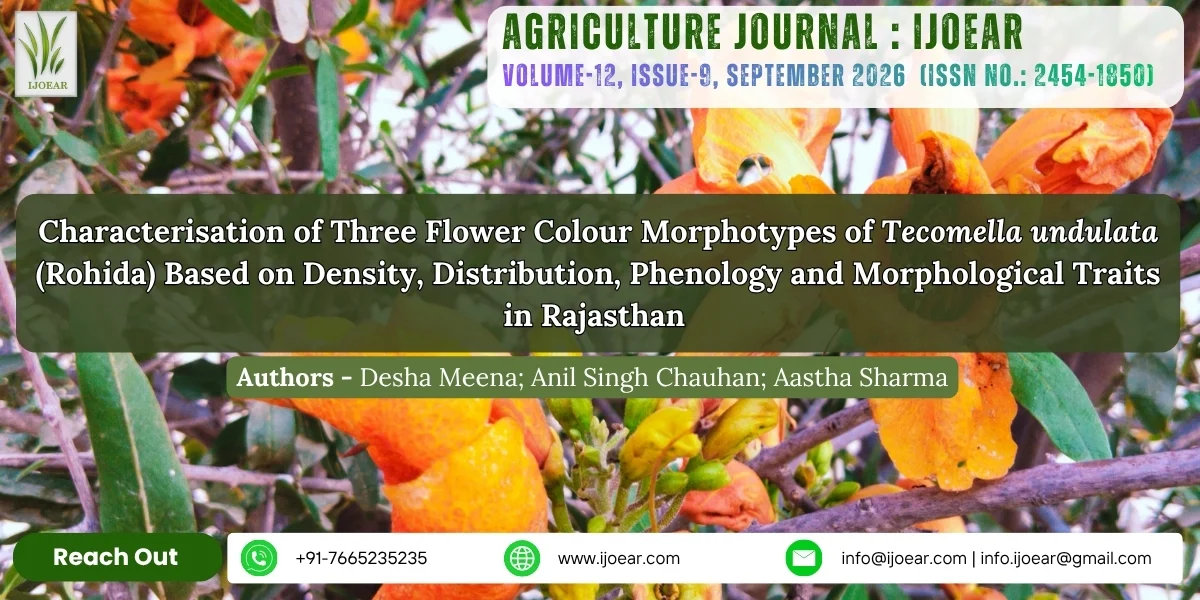
Tecomella undulata (Sm.) Seem., commonly known as Rohida, is one of the most valuable indigenous timber species of the Indian Thar Desert and adjoining semi-arid regions. The species belongs to the family Bignoniaceae and is well adapted to harsh arid climatic conditions (Kritikar and Basu 1993; Nadkarni 2000). Due to overexploitation for wood and medicinal uses, the species is categorised under endangered section in Rajasthan. Besides its importance as quality timber, it contributes significantly to biodiversity conservation, agroforestry systems, and restoration of degraded landscapes thus considered as key stone species of Rajasthan (Kumar et al, 2008). Beyond its importance as a timber species, T. undulata has considerable relevance to agroforestry and range-management systems in the arid and semi-arid regions of Rajasthan. Its ability to survive under low rainfall, high temperature and poor soil conditions makes it a suitable tree component for dryland-based agroforestry and silvopastoral systems. The species can contribute to the diversification and resilience of production systems while providing tree-based ecosystem services and supporting the restoration of degraded lands and rangelands. Incorporation of well-adapted and genetically superior T. undulata planting material into agroforestry and restoration programmes may therefore help in improving the sustainability of land-use systems in the Thar region. Knowledge of its natural distribution, phenological behaviour and morphological variation is particularly important for identifying suitable populations and morphotypes for conservation, enrichment planting and future agroforestry and range-management interventions. This species exhibits considerable phenotypic variation, particularly in flower colour (Fig 1), canopy architecture, and reproductive characteristics (Chakrawati and Chand, 1975; Negi et al., 2011). Due to variation in flower colour, the species is recognised as State flower of Rajasthan (Fig 1) (Chal et al. 2011). Phenological studies particularly flowering and fruiting are vital to develop viable conservation and breeding strategies. Thus knowledge on distribution and phenological pattern of any species is an important approach for improvement and breeding programmes and conservation planning (Beniwal, 2005). Similarly, variability in pod, seed, and leaf traits is also an important step because it serves as important criteria for selecting superior genotypes for quality planting material and genetic improvement. Despite the ecological and economic importance of Rohida, no information is available regarding comparative phenological performance among different flower colour morphotypes. Therefore, to the best of my knowledge present study was carried out to record flowering and fruiting pattern, evaluate variability in pod, seed, and leaf characteristics, and document density and distribution among three different flower colour morphotypes of T. undulata in Rajasthan.
Novelty and Contribution of this Study: While earlier studies have documented morphological variation in T. undulata (Chakravarty and Chand, 1975; Negi et al., 2011) and molecular differentiation among flower colour morphotypes (Kaur et al., 2018; Meena et al., 2025), no study has comparatively assessed the phenological performance of the three flower colour morphotypes across reproductive seasons. This study makes three specific contributions. First, it provides the first comparative account of flowering and fruiting patterns among orange-, red-, and yellow-flowered morphotypes of T. undulata monitored over two consecutive reproductive seasons. Second, it integrates density and distribution data from 14 natural populations across eight districts with morphological and phenological data from a single representative population, thereby linking population-level patterns with individual-tree performance. Third, it reports effect sizes for morphological traits and interprets phenotypic differences cautiously in relation to prior molecular evidence, providing a basis for conservation and quality planting material programmes. By distinguishing between observed phenotypic differences and confirmed genetic differentiation, the study aims to guide future integrated research on this endangered arid-zone tree.
Conclusion
The present study demonstrates considerable phenological and morphological variability among flower colour morphotypes of T. undulata. The results of the study reveal that orange morphotype constituted approximately 67.48% of the natural population among the sampled populations in Rajasthan and exhibited comparatively higher observed flowering and fruiting performance under the study conditions which makes it a promising candidate for genetic improvement, conservation, and quality planting material production. The yellow morphotype was characterized by the widest pods, while seed traits remained relatively stable across morphotypes. Although the orange morphotype appears promising under the study conditions, confirmation of the genetic basis of these differences will require integrated studies involving molecular markers, common-garden experiments, progeny trials, and multi-location evaluation. The three morphotypes together represent valuable components of the biological diversity of T. undulata, and should be conserved as part of representative germplasm collections for future breeding and restoration programmes.

References
- Beniwal, R. S. (2005). Studies on flowering behaviour of arid zone plants.
- Chakravarty, A. K., & Chand, G. (1975). Phenotypic variation in desert teak Tecomella undulata. Annals of Arid Zone, *14*(1).
- Chal, J., Kumar, V., & Kaushik, S. (2011). A phytopharmacological overview on Tecomella undulata G. Don. Journal of Applied Pharmaceutical Science, *1*, 11-12.
- Daneva, V., Johar, V., Pathak, S., Rawat, V., & Khan, S. (2024). Studies on reproductive behaviour and phenology cycle of Tecomella undulata (Sm.) Seem. Plant Science Today. https://doi.org/10.14719/pst.2513
- Kaur, N., Gill, A., & Saggoo, M. I. S. (2018). Cytological investigation and genetic diversity studies in the morphotypes of an endangered tree, Tecomella undulata from Punjab, India. Cytologia, *83*(3), 283-287. https://doi.org/10.1508/cytologia.83.283
- Kritikar, K. R., & Basu, B. D. (1993). Indian medicinal plants. International Book Distributor.
- Kumar, A., Ram, H., Sharma, S. K., & Rao, S. R. (2008). Comparative meiotic chromosome studies in nine accessions of Tecomella undulata (Sm.) Seem., threatened tree of Indian desert. Silvae Genetica, *57*, 301-306.
- Meena, D., Sharma, A., & Chouhan, A. S. (2025). Assessment of genetic variation among three different flower colour morphotypes of Tecomella undulata using start codon targeted markers. Indian Forester, *151*(4), 309-316. https://doi.org/10.36808/if/2025/v151i4/170455
- Nadkarni, K. M. (2000). Indian materia medica. Popular Prakashan.
- Negi, R. S., Sharma, M. K., Sharma, K. C., Kshetrapal, S., Kothari, S. L., & Trivedi, P. C. (2011). Genetic diversity and variations in the endangered tree (Tecomella undulata) in Rajasthan.
- Singh, V. K., Barman, C., & Tandon, R. (2014). Nectar robbing positively influences the reproductive success of Tecomella undulata (Bignoniaceae). PLoS ONE, *9*(7), e102652.
- Tripathi, J. P. M., & Jaimini, S. N. (2002). Floral and reproductive biology of Rohida (Tecomella undulata (Sm.) Seem.). Indian Journal of Forestry, *25*(3), 341-343. https://doi.org/10.54207/bsmps1000-2002-SPT7TE.