
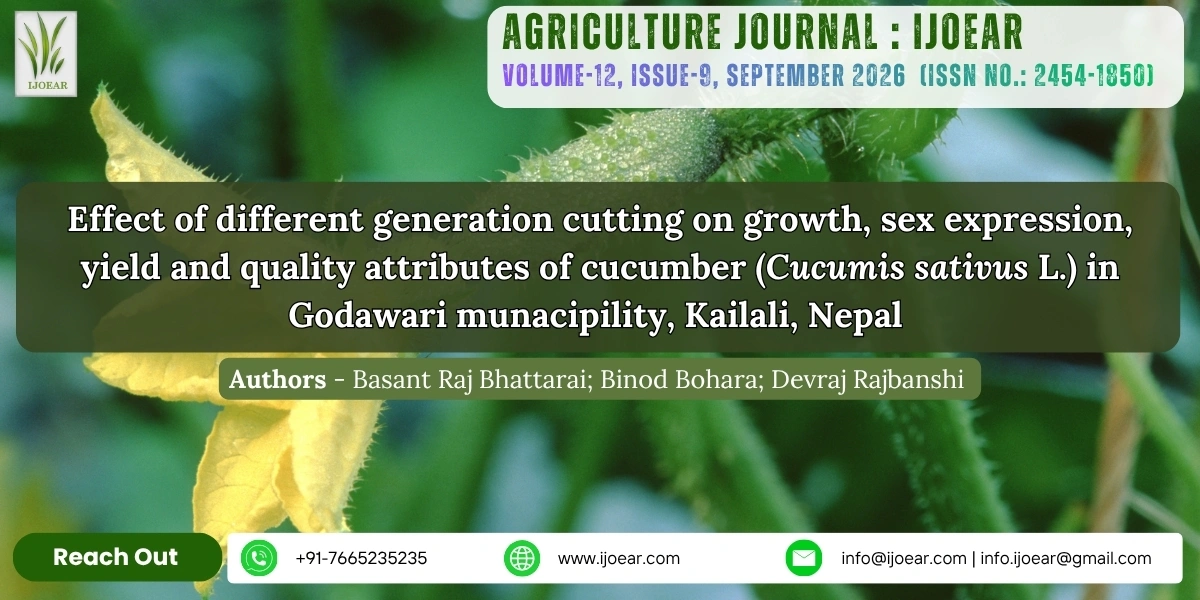
Effect of different generation cutting on growth, sex expression, yield and quality attributes of cucumber (Cucumis sativus L.) in Godawari munacipility, Kailali, Nepal
Abstract
Cucumber (Cucumis sativus L.) is the seventh most important crop in terms of area in Nepal, with the capability of providing abundant minerals and vitamins. The productivity of this crop is less than half the world's average productivity, which is associated with imbalance in male-to-female flower ratio. To address this issue, a field experiment was carried out at the farmers' field of Godawari municipality, Fakalpur, Kailali, Nepal during the summer season of 2023/24 to evaluate the effect of different generation cutting on growth, sex expression, and yield of cucumber cv. Malini. The experiment was laid out in Completely Randomized Block Design (RCBD) with three treatments viz; T1 (No cutting: Control), T2 (First generation cutting: 2G), T3 (Second generation cutting: 3G), and six replications. Each plot consisted of 2 rows and each row consisting of 5 plants with spacing 100 cm × 100 cm. Each replication size was 40 m² so total field size for research was 240 m² consisting of 18 plots each of size 5 m × 2 m. The results indicated that treatment T3 (Second generation cutting: 3G) had a significant effect on phenological parameters, mainly male and female flowers of primary and secondary branches, female flowers on tertiary branches, and male-to-female flower ratio of primary, secondary and tertiary branches. Similarly, yield parameters, mainly number of fruits per plant (6.05) and yield per hectare (21.48 mt/ha) were found to be significantly superior under treatment T3 (Second generation cutting: 3G). Among the different generation cuttings, treatment T3 (Second generation cutting: 3G) was found to be significant over control. It can be concluded that the second generation cutting (3G) can be judiciously used for increasing the sex expression and yield attributes of cucumber.
Keywords
Download Options
Introduction
Cucumber (Cucumis sativus L.), an important vegetable crop, is mainly used as salad and pickles in Nepal. Among the cucurbits, cucumber is a precious vegetable crop grown for consumption of its immature fruits. It is believed to have originated in the hilly areas of Nepal. It has been cultivated in Nepal since ancient times. Currently, it has taken a commercial form as a cash-generating business. Its commercial cultivation is done from the plains to the mountains or in areas with communication and market facilities. In Nepal, its cultivation is done as a seasonal crop in March/April and fruits are harvested till August/September. Cucumber is useful for people suffering from jaundice, kidney problems, constipation, indigestion, and its oil is considered good for the brain and body (Gautam et al., 2021). In Nepal, it is the seventh most important vegetable crop in terms of area. The area, production and productivity of cucumber in Nepal is 9,978 ha, 1,52,862 mt and 15.32 mt/ha respectively (MoALD, 2023). The productivity of cucumber is very low in Nepal as compared to Asia (49.61 mt/ha) and the world average productivity (39.34 mt/ha) (FAO Stat, 2021).
Cucumber is a vine crop. Depending on the variety, its length of vine extends from 2-3 meters to 8-10 meters, and the height of the branches also varies according to the variety. Cucumber vine can be divided into three parts according to gender characteristics, according to which, male flowers grow in the lower part of the vine, male and female flowers grow in the middle or one after the other, and female flowers grow in the upper part of the vine. When cucumbers are planted in winter months, the length of the day is short and the temperature is low, the production of male flowers is low and the production of female flowers is high, while the production of male flowers is high and the production of female flowers is low in cucumbers planted in summer. The main vine of cucumber planted in normal season produces many female flowers. If cucumbers are planted in summer season, after 4-6 nodes of flowering, male flowers appear for 5-6 nodes and then female flowers appear, while in winter season cucumbers, female flowers appear after 2-3 nodes of flowering, but this process can vary depending on the variety. The ratio of male and female flowers should be low for maximum production and quality of cucumbers (Gautam et al., 2006). There is an increasing problem of low fruit set and if there is fruit set, very small fruits are developed that are deteriorated on the mother plant. Imbalance of sex ratio is the main problem of declining production in Nepal and influences the male and female ratio by various biotic and abiotic factors, environmental issues, disease and pest, and many other factors.
According to research studies, the 1st and 2nd generation branches comprise a majority of male flowers rather than female, leading to a very small ratio of 14:1 (Male: Female) flowers in the branch that creates a false illusion of heavy flowering but with very low fruiting (Chaurasiya et al., 2020). Thus, 3rd generation branches flush with a majority of female flowers. The main aim should be focused on keeping 3rd generation branches rather than others. Normally, there is an unequal male-to-female flower ratio in cucumber, with a greater number of male flowers than female flowers. If we use these techniques, the number of female flowers increases, which triggers increased productivity.
The physiological basis for the observed effects of generation cutting on sex expression lies in the manipulation of plant hormone balance and carbohydrate allocation. Pruning alters the source-sink relationships within the plant, redirecting assimilates from vegetative growth to reproductive development. This redirection influences the levels of endogenous plant hormones, particularly gibberellins, auxins, and cytokinins, which play a critical role in sex determination in cucurbits. Gibberellins are known to promote male flower formation, while cytokinins and ethylene promote female flower development. By removing apical dominance through cutting, the distribution of these hormones is altered, favouring female flower production on the tertiary branches. Additionally, pruning improves light penetration and air circulation within the canopy, enhancing photosynthetic efficiency and carbohydrate availability, which supports the development of female flowers and fruits. This mechanistic understanding provides the theoretical foundation for the observed agronomic benefits of 3G cutting.
The present study was therefore undertaken with the following objectives:
- To evaluate the effect of different generation cuttings on growth, sex expression, and yield of cucumber.
- To identify the optimal generation cutting practice for maximizing cucumber productivity in the Godawari municipality area.
Conclusion
The study demonstrates that different generation cutting practices have varying impacts on cucumber growth, flowering, yield, and quality. Specifically, the second-generation branch cutting (3G) showed superior performance in terms of phenological and yield parameters. The ratio of male and female flowers was significantly lower in second-generation branch cutting by 3G cutting with 78.50% and 26.10% over primary and secondary branches, respectively. Similarly, the fruit yield was significantly higher by 3G cuttings with 7.24% and 18.15% increase in yield over 2G and no cutting. In quality parameters, there was similar taste among the different treatments. Thus, for optimizing cucumber production and profitability in similar agro-meteorological conditions, adopting the second-generation branch cutting practice is recommended.
Limitations of the Study: The study was conducted at a single location (Godawari municipality, Kailali) over a single season (summer 2023/24) using a single cultivar (Malini). The results may vary under different agro-ecological conditions, seasons, or with other cultivars. The additional labour requirements for 3G cutting were not quantified, and an economic analysis was not performed. Future research should include multi-location trials across different seasons, evaluation of different cultivars, economic analysis of the cutting practices, and investigation of the physiological mechanisms underlying the observed effects.

References
- Chapagain, U., Bhandari, S., Shrestha, Y. M., Bista, S., & Dahal, J. (2022). Effect of pruning and fertilizers on growth, flowering and yield of cucumber (Cucumis sativus L.) under protected structure in Panchthar, Nepal. International Journal of Applied Sciences and Biotechnology, *10*(3), 171-181.
- Chaurasiya, D. K., Kumar, M., Sahni, S., & Singh, S. (2020). 3G cutting: A wonderful technique to redouble the production of cucurbits. Biotica Research Today, *2*(12), 1308-1310.
- Coggins, C. W., & Lovatt, C. J. (2014). Plant growth regulators. In L. Ferguson & E. E. Grafton-Cardwell (Eds.), Citrus production manual. UC ANR.
- Devi, J., Bakshi, P., Wali, V. K., Kour, K., & Sharma, N. (2016). Role of auxin and dates of planting on growth of cutting raised plantlets of Phalsa (Grewia asiatica L.). The Bioscan, *11*(1), 535-537.
- Dogra, L. K. (2012). Genetic evaluation of some hybrids of cucumber under modified naturally ventilated greenhouse in mid hills of Western Himalayas [M.Sc. thesis]. CSKHPKV.
- Duong, H. X. (1999). Effect of pruning on yield and quality of cucumber [Training report]. AVRDC, Kasetsart University.
- Eifediyi, E. K., & Remison, S. U. (2009). Effect of time of planting on the growth and yield of five varieties of cucumber (Cucumis sativus L.). Report and Opinion, *1*(5).
- Ekwu, L. G., Nwokwu, G. N., & Utobo, E. B. (2012). Effect of mulching materials and pruning on growth and yield of cucumber (Cucumis sativus L.). International Journal of Agriculture and Rural Development, *15*(2), 1014-1021.
- FAO STAT. (2021). Food and Agriculture Organization. Retrieved January 16, 2021.
- Forss, D., Dunstone, E., Ramshaw, E., & Stark, W. (1962). The flavor of cucumbers. Journal of Food Science, *27*, 90-93.
- Gautam, I. P., & Gauli, R. (2006). Year-round production technology of cucumber. Nepal Agriculture Research Council, Regional Agriculture Research Centre.
- Gautam, I. P., Pradhan, N. G., Subedi, S., & Thakur, M. K. (2021). Evaluation of cucumber hybrids for yield and quality under plastic house and open field conditions. Nepalese Horticulture, *15*, 52-63.
- Guan, Y., Hu, W., Wang, L., & Yang, B. (2023). Different cutting methods affect the quality of fresh cut cucumbers by regulating ROS metabolism. Horticulturae, *9*(4), 514.
- Hirama, N., Miusawa, H., & Azuhata, F. (2011). Effects of different levels of greenhouse ventilation and training methods on cucumber growth and yield under forcing culture. Horticultural Research (Japan), *10*, 499-505.
- Humphries, E. G., & Vermillion, D. L. (1994). Pickling cucumber vine pruning treatments and their implications for mechanical harvesting. Transactions of the ASAE, *37*(1), 71-75.
- Jat, G. S. (2011). Studies on hybrid seed production in bitter gourd under insect-proof net house and open-field conditions [M.Sc. thesis]. PG School, ICAR-IARI.
- Khoshkam, S. (2016). The effect of pruning and planting density on yield of greenhouse cucumber in Jiroft. International Journal of Scientific Engineering and Applied Science, *2*(8), 212-227.
- Kumar, A., Kumar, S., & Pal, A. K. (2008). Genetic variability and characters association for fruit yield and yield traits in cucumber. Indian Journal of Horticulture, *65*(4), 423-428.
- Kumar, A., Mishra, S., & Sher, A. (2025). Influence of 3G cutting on the performance of cucumber (Cucumis sativus L.) for growth, yield and quality attributes. International Journal of Research in Agronomy, *8*(8), 174-178.
- Kumar, N. B., & Saravaiya, S. N. (2014). Response of parthenocarpic cucumber to fertilizers and training systems under naturally ventilated polyhouse in sub-tropical conditions. International Journal of Current Research, *6*(8), 8051-8057.
- Madhumala, K., Kumar, V., & Kumar, K. (2024). Physiology and mechanism of pruning in fruit crops. International Journal of Advanced Biochemistry Research, *8*(12), 443-445.
- Mardhiana, A. P., Adiwena, M., Kartina, S. D., Wijaya, R., & Maliki, A. (2017). Effects of pruning on growth and yield of cucumber (Cucumis sativus L.) mercy variety in the acid soil of North Kalimantan, Indonesia. Cell Biology and Development, *1*(1), 13-17.
- Mir, A. A., Sadat, M. A., Amin, M. R., & Islam, M. N. (2019). Pruning: A mechanical stress inducing method to improve growth and yield of Bangladeshi local cucumber variety "Baromashi". International Journal of Business, Social and Scientific Research, *7*(4), 31-35.
- MoALD. (2023). Statistical information on Nepalese agriculture. Ministry of Agriculture and Livestock Development, Government of Nepal.
- Peng, X., Chen, Z., Shi, F., Wu, X., Wang, Y., & Gao, L. (2010). Effects of different grafting methods on growth and fruit quality of cucumber in solar greenhouse. Northern Horticulture, *15*, 122-124.
- Premalatha, M. G. S., Wahundeniya, K. B., Weerakkody, W. A. P., & Wicramathunga, C. K. (2006). Plant training and spatial arrangement for yield improvement in greenhouse cucumber (Cucumis sativus L.) varieties. Tropical Agricultural Research, *18*, 346-357.
- Rajalingam, G. V., Rajasree, V., Arumugam, T., & Saraswathi, T. (2017). Influence of different training systems in cucumber under naturally ventilated poly house. International Journal of Chemical Studies, *5*(6), 1453-1455.
- Shah, P. S., Nabi, G., Khan, M., Hussain, S., & Jan, J. A. (2020). Performance of sponge gourd cultivars under organic and inorganic fertilizer regimes. Sarhad Journal of Agriculture, *36*(2), 478-488.
- Shivaraj, D., Lakshminarayana, D., Prasanth, P., & Ramesh, T. (2018). Studies on the effect of pruning on cucumber cv. Malini grown under protected conditions. International Journal of Current Microbiology and Applied Sciences, *7*, 2019-2023.
- Singh, A. K., Munsi, A. D., Veerpal, S., Mukul, K., & Sellam, P. (2016). Influence of gynoecious cucumber varieties and spacing on yield and economics during off-season production under protected condition in North Indian plains. International Journal of Basic and Applied Agricultural Research, *14*, 54-58.
- Verma, A. K., Goutam, E., Gangwar, V., Singh, P., Prajapati, J., Singh, D., Mishra, A. K., Patel, V., & Singh, R. (2023). 3G cutting: An innovative tool in cucurbitaceous crops to boost the production and doubling the income of small farmers in a per unit area. International Journal of Plant & Soil Science, *9*(35), 71-76.
- Wang, W., Miao, H., Dong, S., & Zhang, S. (2019). QTL mapping and genome-wide association study reveal two novel loci associated with green flesh color in cucumber. BMC Plant Biology, *19*, 243.
- Yu, K., Fan, Q., Wang, Y., Wei, J., Ma, Q., Yu, D., & Li, J. (2013). Function of leafy sepals in Paris polyphylla: Photosynthate allocation and partitioning to the fruit and rhizome. Functional Plant Biology, *40*, 393-399.
- Zhang, S., Guo, Y., & Xu, C. (2004). Inheritance of bitterness in cucumber. Acta Horticulturae Sinica, *31*, 613-616.