
Harnessing Solar Energy for Pumping Machines during Dry Seasons: Implications for Agribusiness among Adult Learners
Abstract
The escalating challenge of water scarcity during dry seasons continues to impede smallholder agricultural productivity across Sub-Saharan Africa, including Nigeria. This journal article examines the adoption of solar-powered pumping machines as a renewable and cost-effective water management solution, with particular emphasis on its implications for agribusiness among adult learners. Drawing on a review of empirical studies, field surveys, and adult education frameworks, the paper explores the technical dimensions of solar pumping systems, their economic viability, environmental sustainability, and the critical role of adult learning in facilitating technology adoption. The study identifies barriers to adoption — including high initial cost, limited technical literacy, and inadequate policy support — alongside enabling factors such as community-based learning models, government incentive schemes, and access to microfinance. The findings suggest that integrating solar pumping technology into adult agricultural education curricula can significantly enhance agribusiness productivity and profitability. Policy recommendations for stakeholders, extension officers, and educational institutions are provided.
Keywords
Download Options
Introduction
Water is the lifeblood of agriculture. In many parts of sub-Saharan Africa, including the savanna and semi-arid zones of Nigeria, smallholder farmers face extreme water stress during the dry season — typically spanning from November to April — when rainfall ceases and surface water bodies recede. This seasonal dearth of water forces farmers to rely on costly, often unreliable diesel-powered pumps or to abandon farmland entirely, resulting in significant losses of income and food production potential.
Nigeria, as Africa's most populous nation and a country whose rural economy is dominated by smallholder agriculture, faces these challenges acutely. The National Bureau of Statistics estimates that over 70% of Nigerians engaged in agriculture are smallholders operating on less than two hectares of land. Their vulnerability to climate variability, particularly the lengthening of dry seasons attributed to climate change, places their livelihoods in perpetual jeopardy. Agricultural output losses during the dry season contribute significantly to rural food insecurity and poverty.
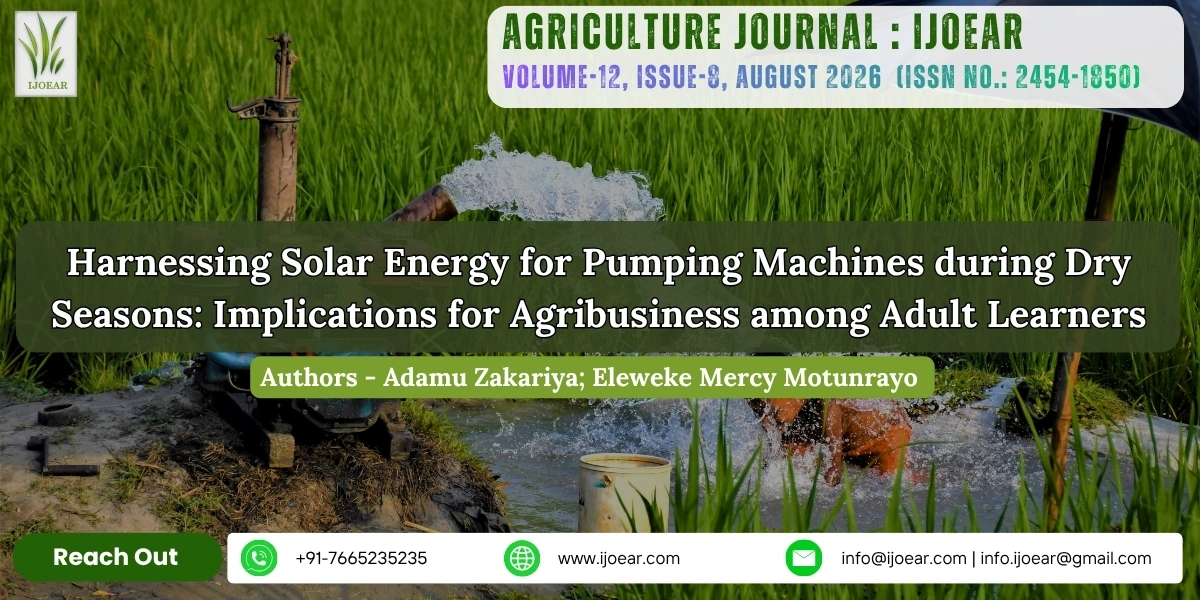
Solar energy has emerged as a transformative technological response to this crisis. Photovoltaic (PV)-powered water pumping systems harness sunlight — an abundant, free, and inexhaustible resource — to drive submersible or surface pumps that draw water from boreholes, wells, rivers, and reservoirs. Unlike diesel-powered alternatives, solar pumps eliminate fuel costs, reduce carbon emissions, require minimal maintenance, and can operate in remote locations without grid connectivity. These attributes make solar pumping particularly well-suited for smallholder irrigation in Nigeria and across the developing world.
Conclusion
This journal article has examined the adoption of solar-powered pumping machines for dry-season irrigation and its implications for agribusiness among adult learners. The evidence is unambiguous: solar irrigation is a technically viable, economically advantageous, and environmentally sound solution to the perennial challenge of dry-season water scarcity. Its potential to transform smallholder agribusiness — enabling year-round production, income diversification, and market competitiveness — is substantial and supported by robust empirical evidence from Nigeria and comparable contexts.
Adult learners, as the primary agents of agricultural transformation in rural Nigeria, must be at the center of solar irrigation uptake strategies. Achieving meaningful adoption at scale requires an enabling ecosystem comprising accessible financing, quality adult education, supportive policy, responsive extension systems, and inclusive social design.

References
[1] Adekoya, A. E., & Ishola, T. A. (2022). Solar-powered irrigation and smallholder productivity in northern Nigeria: Evidence from Kano and Jigawa States. African Journal of Agricultural Research, *17*(4), 512-528.
[2] Aliyu, M. D., Garba, A., & Usman, Y. (2021). Barriers to solar water pump adoption among rural farmers in Sokoto State, Nigeria. Journal of Rural Development Studies, *9*(1), 88-105.
[3] Babatunde, R. O., Omotesho, O. A., & Sholotan, O. S. (2020). Dry season vegetable farming and income diversification in smallholder households of the Nigerian savanna: The role of irrigation. Tropical Agriculture, *97*(3), 180-194.
[4] Federal Ministry of Agriculture and Rural Development. (2023). Report of the national agricultural extension needs assessment: Technology adoption and capacity gaps. FMARD.
[5] Food and Agriculture Organization of the United Nations. (2021). Solar-powered irrigation systems (SPIS) — Tool for assessment of solar irrigation potential. FAO.
[6] Giordano, M., Barron, J., & Ünver, O. (2019). Water scarcity and water stress in agriculture. In P. Steduto et al. (Eds.), Crop yield response to water (FAO Irrigation and Drainage Paper No. 66). FAO.
[7] International Finance Corporation. (2022). Pay-as-you-go solar for smallholder agriculture in sub-Saharan Africa: Market opportunities and risk landscape. IFC.
[8] International Water Management Institute. (2020). Solar-powered irrigation in Nigeria: Opportunities and constraints for smallholder farmers (IWMI Research Report 175). IWMI.
[9] Knowles, M. S., Holton, E. F., & Swanson, R. A. (2015). The adult learner: The definitive classic in adult education and human resource development (8th ed.). Routledge.
[10] Mezirow, J. (1997). Transformative learning: Theory to practice. New Directions for Adult and Continuing Education, *74*, 5-12.
[11] Muhammed, A. K., & Abdullahi, S. A. (2023). Cost-benefit analysis of solar irrigation among smallholder farmers in Katsina State. Nigerian Journal of Agricultural Extension, *24*(2), 44-58.
[12] Nigerian Meteorological Agency. (2023). Annual solar radiation and sunshine hours report for Nigeria, 2022. NiMet.
[13] Ogunrinde, A. T., Oguntunde, P. G., Akinwumiju, A. S., & Fasinmirin, J. T. (2020). Analysis of recent changes in rainfall and drought indices in Nigeria, 1981–2015. Heliyon, *6*(3), e03672.
[14] Rural Electrification Agency. (2023). Energizing agriculture programme: Progress report 2022–2023. REA.
[15] SunCulture. (2022). RainMaker2 solar irrigation impact report: Kenya smallholder farmer outcomes 2020–2022. SunCulture Kenya Ltd.
[16] United Nations Development Programme. (2022). Accelerating renewable energy access in rural Africa: Country case studies and lessons for scale. UNDP.
[17] World Bank. (2021). The potential of solar energy to support sustainable water management and food security in sub-Saharan Africa. World Bank.