
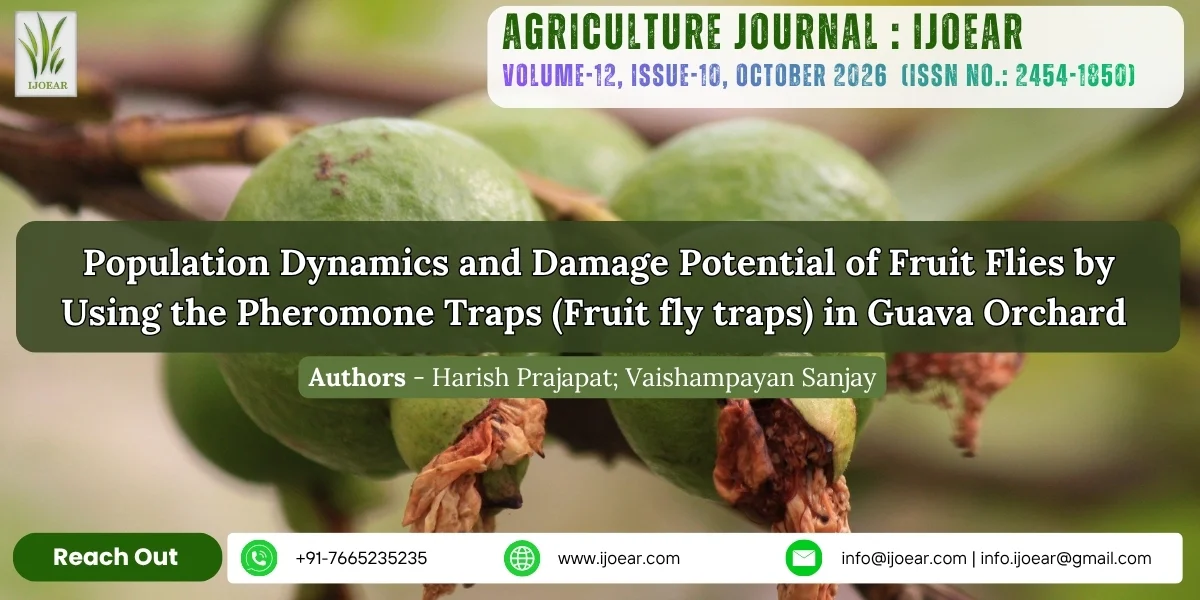
Population Dynamics and Damage Potential of Fruit Flies by Using the Pheromone Traps (Fruit fly traps) in Guava Orchard
Abstract
A field investigation was undertaken at KVK, Katni, Madhya Pradesh, from September 2025 to January 2026 to characterize the population dynamics and damage potential of fruit flies (Bactrocera spp.) in a guava (Psidium guajava L.) orchard. Seasonal activity was monitored using fruit fly traps with a methyl eugenol-based biodegradable lure. The relationships between fruit fly population and weather parameters were also examined. Fruit fly abundance exhibited a progressive increase from the 36th SMW, attaining a maximum of 42.50 flies/trap/week in the 43rd SMW, and subsequently declined gradually. A comparable pattern was observed in fruit infestation, which increased from 8.33 per cent to 41.67 percent during the study period. Significant positive correlations were observed between fruit fly population and maximum temperature, minimum temperature and relative humidity, whereas rainfall and wind speed showed non-significant relationships. The regression model accounted for approximately 81 per cent of the variation in fruit fly population through the selected weather parameters. These findings establish a close relationship between fruit fly population abundance and fruit infestation and support the use of methyl eugenol traps for monitoring seasonal activity and facilitating timely management of fruit flies in guava orchards.
Keywords
Download Options
Introduction
Guava (Psidium guajava L.), a member of the family Myrtaceae, is an important tropical fruit crop cultivated widely for its nutritious value. Commonly referred to as the "Apple of the Tropics," it originated in tropical America and is now extensively grown throughout tropical and subtropical regions (Baloda et al., 2018). India is the world's largest guava producer, contributing nearly 46% of global production. During 2024-25, guava was cultivated on 3.58 lakh ha with an estimated production of 53.50 lakh tonnes. Uttar Pradesh and Madhya Pradesh are the leading producing states (Anonymous, 2025). Guava production is constrained by several insect pests, of which fruit flies (Bactrocera spp.) are the most economically damaging. Other important pests include the mealybug (Ferrisia virgata), fruit and shoot borer (Conogethes punctiferalis), tea mosquito bug (Helopeltis antonii), and bark-eating caterpillar (Indarbela tetraonis) (Gundappa et al., 2018). Fruit fly infestation can cause severe quantitative and qualitative losses, with damage varying according to pest abundance, cultivar, and environmental conditions (Kumar et al., 2011). Fruit flies belong to the family Tephritidae, which comprises over 4,000 described species. Among them, the genus Bactrocera is one of the most economically significant, containing nearly 500 species distributed mainly across Asia and Australia (Majeed et al., 2024). While numerous species are known to infest fruits, merely a limited number are encountered within orchard environments. The recorded data concerning fruit fly population fluctuations in guava cultivation systems presents both prospects and obstacles for adequate strategic planning and implementing appropriate management interventions at optimal timings (Vignesh et al., 2020).
Conclusion
The fruit fly population exhibited a clear seasonal pattern, first appearing in the 36th SMW, reaching its peak in the 43rd SMW, and declining thereafter. The highest trap catch (42.50 flies/trap/week) and maximum fruit infestation (41.67%) were both recorded during the 43rd SMW, identifying this as the most critical period for fruit fly damage in guava. Fruit infestation closely followed adult fly abundance, indicating that pheromone trap catches are a reliable predictor of infestation. Multiple regression analysis showed that weather variables explained approximately 81% of the variation in fruit fly population, confirming the important role of climatic factors in seasonal population dynamics.

References
[1] Abbott, W. S. (1925). A method of computing the effectiveness of insecticide. Journal of Economic Entomology, *18*, 265-267.
[2] Agarwal, M. L., & Kumar, P. (1999). Population dynamics and damage potential of fruit flies in guava. Indian Journal of Entomology, *61*(2), 123-128.
[3] Anonymous. (2025). Agricultural marketing report—Guava (Ambe Bahar): Pre-sowing and pre-harvest forecast report (2025). Department of Agricultural Economics and Farm Management, Punjab Agricultural University.
[4] Baloda, S., Sharma, J. R., Kumar, M., Singh, S., & Malik, A. (2018). Studies on performance of rejuvenated plants and fresh plants of guava. International Journal of Pure and Applied Bioscience, *6*(1), 939-941.
[5] Chandra, A., Bhagawati, K., Kalita, H., & Angami, T. (2022). Weather-based fruit fly population dynamics prediction model for the mid-hills of Eastern Himalayan region of India. Current World Environment, *17*(3), 690-697.
[6] Giddi, T. D., & Emmanuel, N. (2023). Seasonal incidence of fruit fly in guava cv. Taiwan White. Ecology, Environment and Conservation, *29*(3), 218-221.
[7] Gundappa, B., Rajkumar, M. B., Singh, S., & Rajan, S. (2018). Pests of guava. In O. Omkar (Ed.), Pests and their management (pp. 491-510). Springer Nature Singapore.
[8] Gupta, J. P., & Bhatia, R. (2000). Seasonal incidence of Bactrocera dorsalis and Bactrocera zonata in North India. Journal of Fruit Science, *17*(1), 12-18.
[9] Haseeb, M. (2007). Seasonal incidence of fruit flies and fruit infestation in guava. Annals of Plant Protection Sciences, *15*(1), 89-93.
[10] Khomane, K. B., Datkhile, R. V., Aghav, S. T., Kadu, R. V., & Todkar, A. A. (2023). Seasonal incidence and management of guava fruit fly. The Pharma Innovation Journal, *12*(1), 1187-1191.
[11] Kruthika, K. S., Gundannavar, K. P., Kambrekar, D. N., & Biradar, M. S. (2025). Studies on population dynamics of major pests of guava and their natural enemies in Dharwad, Karnataka, India. Plant Archives, *25*(Supplement 1), 3068-3072.
[12] Kumar, P., Abubakar, Linda, A., Ketelaar, J. W., & Shanmugam, V. (2011). Fruit fly damage and crop losses. In Field exercise guide on fruit flies integrated pest management (p. 17). Asian Fruit Fly IPM Project.
[13] Majeed, D. M., Majeed, A., Jamali, M., & Mir, R. A. (2024). Species diversity of fruit flies (Bactrocera spp.) in guava orchards of Sahanpur District of Uttar Pradesh. Journal of Entomology and Zoology Studies, *12*(1), 11-16.
[14] Math, M. A., Kotikal, Y. K., & Ganiger, V. M. (2018). Species diversity and population dynamics of fruit flies in guava ecosystem. International Journal of Current Microbiology and Applied Sciences, *7*(12), 2269-2283.
[15] Raina, S., Sharma, D., & Singh, M. (2023). Impact of weather parameters on population dynamics of fruit flies (Bactrocera spp.) on phalsa (Grewia asiatica Linn.). International Journal of Environment and Climate Change, *13*(11), 735-741.
[16] Sarada, G., Maheswari, T. U., & Purushotham, K. (2001). Seasonal incidence of fruit flies in guava orchard.
[17] Shukla, R. P., & Prasad, P. G. (1985). Population fluctuation of the oriental fruit fly, Dacus dorsalis Hendel, in relation to host and abiotic factors. Tropical Pest Management, *31*, 273-275.
[18] Singh, A., Singh, K., & Singh, B. (2024). Seasonal incidence of the guava fruit fly, Bactrocera spp. in Talwandi Sabo, Punjab. Environment and Ecology, *42*(4C), 2068-2074.
[19] Su, C. Y. (1984). The study on the relationship between seasonal succession of male adult of melon fly, Dacus cucurbitae, and meteorological factors. Journal of Agriculture and Forestry, *32*, 105-109.
[20] Umesh, Kumar, R., & Meenu. (2025). Seasonal incidence and ecofriendly management of Bactrocera spp. fruit flies in guava (Psidium guajava L.): A review. International Journal of Horticulture and Food Science, *7*(5), 97-101.
[21] Verghese, A., & Sudhadevi, K. (1998). Relation between trap catches of Bactrocera dorsalis and abiotic factors. In Advances in IPM for horticultural crops.
[22] Vignesh, S., Chandrasekaran, M., Ambethgar, V., & Jeeva, S. (2020). Species diversity and population dynamics of fruit flies in guava orchards. Journal of Entomology and Zoology Studies, *8*(3), 615-619.