Agriculture is undergoing a major transformation as farmers face rising production costs, unpredictable weather patterns, soil degradation, water scarcity, and increasing demand for food. Traditional farming practices often rely on uniform treatments across entire fields, even when soil conditions, moisture levels, and crop requirements vary considerably from one area to another.
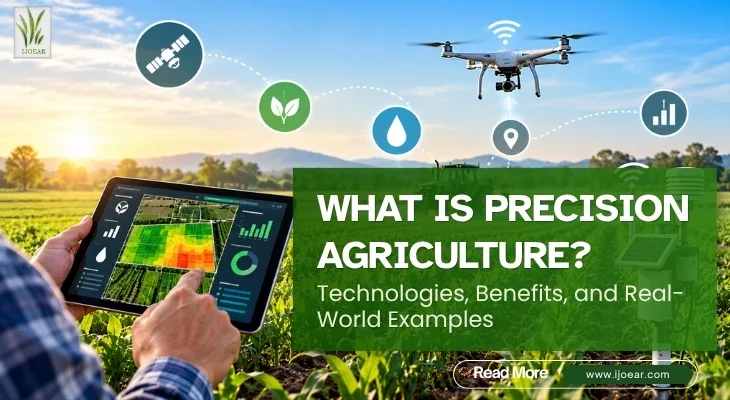
Precision agriculture offers a more targeted approach. It uses technologies such as GPS, satellite imagery, sensors, drones, artificial intelligence (AI), and data analytics to help farmers make informed decisions about crop production.
Instead of treating every part of a field identically, precision agriculture enables farmers to identify specific areas that need irrigation, fertilizer, pest management, or other interventions. This approach can improve resource efficiency, reduce unnecessary input use, and support more sustainable agricultural production.
In 2026, precision agriculture is becoming increasingly relevant to commercial farms, agricultural researchers, universities, agritech companies, and policymakers. Its applications range from monitoring crop health and predicting yields to automating machinery and optimizing water management. Related developments in IoT sensor networks for smart farming automation and pest detection show how connected field data is reshaping day-to-day farm decisions.
Understanding how these technologies work—and where they deliver measurable benefits—is essential for evaluating the future of data-driven agriculture.
How Precision Agriculture Works
Precision agriculture follows a simple principle: collect reliable field data, analyze it, and use the results to make location-specific farming decisions.
A precision farming system typically involves several connected stages.
1. Data Collection
Farmers collect information about soil properties, crop growth, weather conditions, moisture levels, and pest activity. Data may come from satellite images, field sensors, drones, GPS-enabled machinery, and soil sampling.
2. Data Analysis
Specialized software processes the collected information to identify patterns and variations. For example, a field map may reveal areas experiencing water stress or regions with lower nutrient availability.
3. Decision-Making
Farmers use these insights to determine where and when specific interventions are needed. Decisions may involve adjusting fertilizer rates, changing irrigation schedules, or investigating possible disease outbreaks.
4. Targeted Implementation
GPS-guided machinery, variable-rate applicators, automated irrigation systems, and other technologies help implement decisions at the appropriate locations.
5. Monitoring and Improvement
Farmers evaluate the results and use new data to improve future decisions. Over time, this process can build a more detailed understanding of field performance.
The technologies required vary depending on farm size, crop type, budget, connectivity, and production goals. Precision agriculture does not necessarily require a fully automated farm; even basic soil mapping and targeted irrigation can provide useful benefits.
Key Technologies Used in Precision Agriculture
Several technologies work together to make precision agriculture possible. Each addresses a different aspect of farm management.
Global Positioning System (GPS) and Geographic Information Systems (GIS)
GPS enables agricultural machinery and field equipment to determine their positions accurately. Geographic Information Systems (GIS) organize spatial data into maps that farmers can use to understand variations across their land.
These technologies support:
- Accurate field mapping
- GPS-guided planting and harvesting
- Reduced overlap during fertilizer and pesticide application
- Mapping of soil fertility and crop performance
- Location-specific farm records
For example, a farmer can use GIS maps to identify areas with consistently poor crop growth and investigate whether the problem is related to soil composition, drainage, or nutrient availability.
Remote Sensing and Satellite Imagery
Remote sensing uses satellite-based or airborne instruments to collect information about agricultural fields without requiring direct contact with every plant.
Multispectral and hyperspectral sensors capture reflected light across different wavelengths. Researchers can analyze these measurements to assess vegetation condition, detect potential stress, and monitor crop development.
One commonly used indicator is the Normalized Difference Vegetation Index (NDVI), which uses red and near-infrared reflectance to estimate vegetation greenness and vigor.
Satellite monitoring can help farmers identify areas that may require closer inspection. However, NDVI does not independently diagnose a particular nutrient deficiency or disease; field verification is usually necessary.
Satellite imagery is particularly useful for monitoring large farms, assessing seasonal crop development, and supporting regional agricultural analysis. Combined with geospatial analytics for climate risk assessment, this data helps growers anticipate weather-driven threats across wider regions.

Agricultural Drones
Drones provide detailed aerial information that can complement satellite imagery. Depending on their sensors, they can capture high-resolution photographs, multispectral images, and thermal measurements.
Their applications include:
- Detecting uneven crop growth
- Identifying irrigation problems
- Monitoring pest or disease symptoms
- Assessing crop damage after extreme weather
- Creating detailed field maps
Some agricultural drones are also designed to apply fertilizers, pesticides, or other products. Such applications must comply with local aviation, pesticide, and environmental regulations.
Drones are especially valuable when farmers need detailed information about small areas or when satellite images are affected by cloud cover or insufficient spatial resolution. This complements broader trends in agri-robotics and autonomous machines transforming modern agriculture.
Soil and Crop Sensors
Sensors provide real-time or near-real-time information about field conditions.
Soil moisture sensors measure water availability, while electrical conductivity sensors help assess variations in soil properties. Other instruments measure temperature, nutrient-related parameters, or crop canopy conditions.
When connected to irrigation equipment, soil moisture sensors can help determine when crops need water.
For example, a sensor-based irrigation system may delay watering after rainfall if the root zone already contains sufficient moisture. This can reduce unnecessary water application and pumping costs.
Sensor accuracy, placement, calibration, and maintenance are important because unreliable measurements can lead to incorrect management decisions. Soil sensor data becomes far more valuable when paired with proper soil health indicators, testing methods, and management strategies.
Artificial Intelligence and Machine Learning
Artificial intelligence is increasingly used to analyze the large datasets generated by precision farming technologies.
Machine learning models can identify patterns in historical weather, soil measurements, satellite images, and crop observations. Depending on the quality of their training data, these models may support:
- Yield forecasting
- Pest and disease risk assessment
- Irrigation recommendations
- Weed identification
- Crop growth monitoring
- Machinery optimization
For example, a computer vision system may identify weeds within crop rows and guide targeted weed-control equipment. Similar AI models power rice brown spot disease prediction using weather-based forecasting.
However, AI predictions are not automatically accurate. Models may perform poorly when applied to crops, climates, or farming systems that differ from their training data. Human oversight and local validation remain important.
Variable-Rate Technology
Variable-rate technology allows agricultural machinery to adjust the amount of an input according to location-specific requirements.
Instead of applying a uniform fertilizer rate across an entire field, a variable-rate applicator can use soil maps or prescription files to distribute different amounts across management zones.
Applications include:
- Fertilizer application
- Seeding rates
- Lime application
- Irrigation management
- Selected crop protection treatments
The goal is to match inputs more closely to crop needs, rather than simply increasing or decreasing application rates everywhere.
Major Benefits of Precision Agriculture
Precision agriculture can improve farm management in several ways, although actual outcomes depend on the technology, crop, climate, and quality of implementation.
More Efficient Use of Water
Water scarcity is a major concern in many agricultural regions. Sensor-guided irrigation and weather-based scheduling help farmers apply water when and where it is needed.
These systems may reduce over-irrigation, improve water productivity, and limit nutrient leaching.
In water-intensive crops, better irrigation scheduling can also reduce energy expenditure associated with pumping. These practices align closely with water conservation and smart irrigation systems and with research on low-water precision irrigation systems.
Reduced Fertilizer and Pesticide Waste
Uniform field treatments can lead to excessive applications in some areas and insufficient treatment in others.
Precision technologies help identify field variability and support targeted application. Weed detection systems, for example, can guide localized herbicide treatment instead of blanket spraying where the technology and operating conditions permit.
The result may be lower input use, reduced application costs, and less environmental exposure. However, savings are not guaranteed and should be measured against a conventional management baseline. Approaches rooted in sustainable pest and disease management and precision agriculture efficiency and waste reduction provide useful frameworks for measuring these gains.
Improved Crop Monitoring and Yield Potential
Frequent monitoring helps farmers detect emerging problems before they become widespread.
An area showing declining vegetation vigor may indicate water stress, nutrient limitations, pest damage, disease, or another issue. Early investigation can help farmers intervene before losses become more severe.
Precision agriculture can also support yield estimation and harvest planning, although forecasts remain subject to weather and other uncertainties.
Lower Operating Costs
Although precision technologies require an initial investment, they may reduce selected recurring expenses by improving machinery efficiency and input management.
Potential savings include:
- Reduced overlap during field operations
- Lower fuel consumption in some operations
- More efficient fertilizer use
- Better irrigation scheduling
- Reduced unnecessary crop treatments
The financial return depends on farm size, equipment costs, labor availability, and the value of the inputs being optimized.
Improved Environmental Sustainability
Applying agricultural inputs more precisely can reduce nutrient runoff, pesticide drift, and unnecessary water use.
Better field management may also support soil conservation and improve the efficiency of agricultural resource use.
Nevertheless, precision agriculture is not inherently sustainable in every application. Environmental benefits depend on the decisions farmers make using the technology. The wider climate-smart agriculture approach to addressing climate change offers a useful lens for evaluating these outcomes.
Real-World Examples of Precision Agriculture
Precision agriculture is already being used in different farming systems around the world. The following examples illustrate practical applications rather than suggesting that every farm achieves identical results.
1. United States: Precision Irrigation and Fertilizer Management
In parts of the United States, producers use GPS-guided machinery, soil sensors, yield monitors, and variable-rate equipment to manage large fields. These tools help farmers account for differences in soil properties, crop performance, and water availability when planning field operations.
2. India: Sensor-Based Irrigation and Crop Advisory
Indian farms are exploring drip irrigation, soil moisture monitoring, weather-based advisories, and mobile agricultural platforms. In crops such as cotton, horticultural produce, and sugarcane, these tools can help farmers schedule irrigation and make more informed crop management decisions. Affordability and access to technical support influence adoption.
3. Brazil: Precision Management in Large-Scale Crop Production
Large-scale soybean, maize, and other crop producers use satellite imagery, GPS-guided machinery, yield mapping, and variable-rate applications. These technologies help manage field variability across extensive agricultural areas and improve the coordination of planting, fertilization, and harvesting.
4. Netherlands: Sensor-Driven Greenhouse Production
Greenhouse growers use environmental sensors and automated control systems to regulate temperature, humidity, lighting, irrigation, and nutrient delivery. These systems allow highly controlled crop production and can improve resource efficiency when carefully calibrated to crop requirements. This links closely with smart farming on a budget using solar IoT greenhouses and with vertical and indoor farming as part of urban agriculture.
These examples demonstrate that precision agriculture can be adapted to different scales and production environments. A large commercial farm may rely on automated machinery and extensive spatial datasets, while a smaller farm may benefit from a soil moisture sensor and a mobile weather advisory.
Challenges and Limitations of Precision Agriculture
Despite its advantages, precision agriculture faces several practical barriers.
High Initial Investment
Drones, sensors, GPS-guided machinery, and specialized software can be expensive. Smaller farms may find it difficult to justify the investment without subsidies, shared services, or a clear financial return.
Data Quality and Interpretation
Poor sensor calibration, incomplete datasets, and inaccurate recommendations can lead to incorrect decisions. Farmers also need the skills to interpret maps and translate technical information into practical actions.
Connectivity and Infrastructure
Some agricultural regions lack reliable internet access, mobile connectivity, electricity, or technical support. These limitations can reduce the usefulness of connected farming systems.
Data Ownership and Privacy
Farm data may contain commercially valuable information about yields, field conditions, input use, and farm operations. Farmers need clarity about who can access this information, how it is stored, and whether it can be shared with third parties.
Compatibility Between Systems
Equipment and software from different providers do not always exchange information smoothly. Interoperability remains important for farmers who want to combine sensors, machinery, and data platforms.
How Farmers Can Start Using Precision Agriculture
Adopting precision agriculture does not require replacing an entire farm management system at once. A gradual approach can help farmers identify technologies that provide practical value.
- Identify a specific problem. Start with an issue such as high irrigation costs, uneven crop growth, or excessive fertilizer use.
- Establish a baseline. Record current input costs, yields, water use, and other relevant measurements.
- Choose a suitable technology. Select a sensor, mapping tool, advisory service, or precision application system that addresses the identified problem.
- Test on a limited area. Compare results with a similar area managed using existing practices.
- Evaluate costs and benefits. Account for equipment, maintenance, training, labor, and changes in crop performance.
- Expand when results justify it. Scale up only when the technology demonstrates practical and economic value.
Agricultural extension services, universities, research institutions, and local agritech providers can help farmers select appropriate tools and interpret results. Farmers exploring these pathways may also find guidance in building a career in agriculture and environmental science.
The Future of Precision Agriculture in 2026 and Beyond
Precision agriculture is moving toward more connected and predictive farming systems. Improvements in remote sensing, machine learning, autonomous machinery, and low-cost sensors are expanding the range of decisions that can be supported by field data.
Emerging applications include robotic weed control, automated crop scouting, digital twins of agricultural systems, and AI-supported farm planning.
Researchers are also investigating ways to combine genomic information, soil health measurements, weather forecasts, and field observations to develop more comprehensive crop management strategies. This intersects with AI-powered phenotyping and genomics integration and with new technologies in crop science.
However, the future of precision agriculture will not depend on technology alone. Reliable data, farmer training, affordable equipment, transparent data practices, and independent evaluation will be equally important.
For researchers and agricultural professionals, a key priority is determining which technologies deliver measurable improvements under specific farming conditions, rather than assuming that digital tools automatically improve productivity.
Building More Productive and Sustainable Farming Systems
Precision agriculture represents a shift from uniform field management toward decisions informed by location-specific data. Through GPS, remote sensing, drones, sensors, AI, and variable-rate equipment, farmers can better understand field conditions and respond to crop requirements.
Its potential benefits include improved water and fertilizer efficiency, more targeted pest management, earlier identification of crop stress, and better-informed operational decisions. Real-world applications across the United States, India, Brazil, and the Netherlands demonstrate how these technologies can support different agricultural systems.
At the same time, investment costs, data quality, infrastructure, and technical skills remain important considerations.
The most effective approach is to select technologies according to clearly defined farm needs, test their performance, and evaluate both economic and environmental outcomes. When applied thoughtfully, precision agriculture can help build more efficient, resilient, and sustainable farming systems.
Continue Exploring
- Precision Agriculture: Maximizing Efficiency and Minimizing Waste
- IoT Sensor Networks in Smart Farming: Automation, Pest Detection, and Future Research
- Agri-Robotics 2025: Autonomous Machines Transforming Modern Agriculture
- Smart Farming on a Budget: Solar IoT Greenhouses
- Water Conservation and Smart Irrigation Systems
- What Is Soil Health? Key Indicators, Testing Methods, and Management Strategies